
Slowing Down of Atoms in Metals Studied by the Doppler-Broadened Gamma-Ray Line Shape
Slowing Down of Atoms in Metals Studied by the Doppler-Broadened Gamma-Ray Line Shape
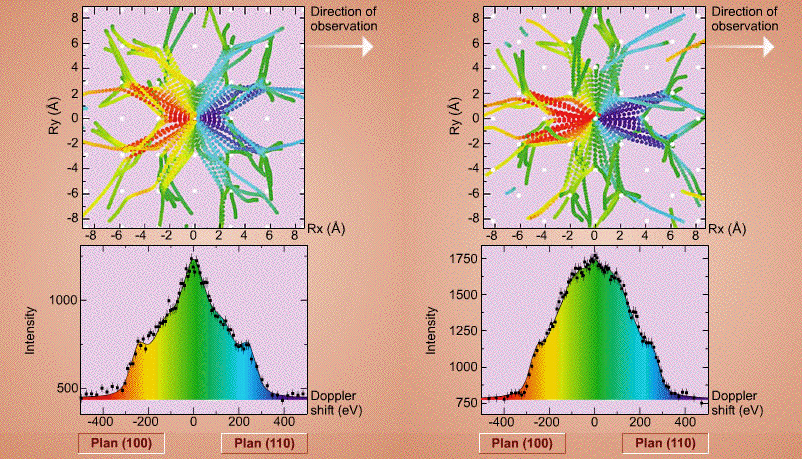
Molecular-dynamics simulations describing the slowing down of atoms in solids are used to study inter-atomic potentials in metals. This analysis is achieved by observing the fine structures of Doppler-broadened gamma-rays emitted by recoiling exited nuclei.
The recoil of the atom, 400 eV kinetic energy, is generated by the emission of a preceding gamma-ray following thermal-neutron capture. The experiment was performed with oriented single crystals of Fe and Cr as target and high-resolution gamma-ray spectroscopy.
Two different nuclear levels for each element were studied and best inter-atomic potential among many available in the literature could be deduced from the data. The construction of a different potential was also investigated with this technique. Lifetime values with a much improved precision were obtained for four exited nuclear levels.
Ref.: Stritt N., Jolie J., Jentschel M., Boerner H.G., Lehmann H.; Physical Review B 60, 6476-6483 (1999).