Relaxor ferroelectrics
Relaxor ferroelectrics
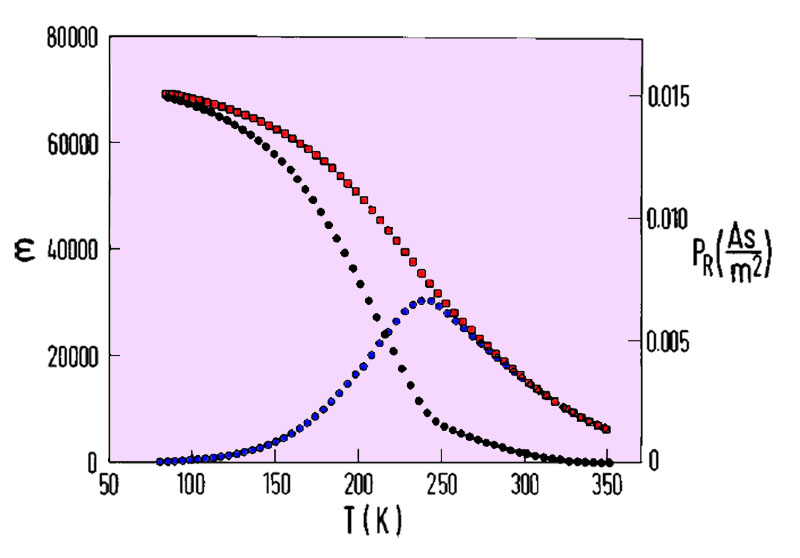
Relaxor ferroelectrics are materials with extraordinarily high electrostrictive constants. They are characterized by a diffuse phase transition, a giant dielectric permitivity, a strong piezoelectricity.
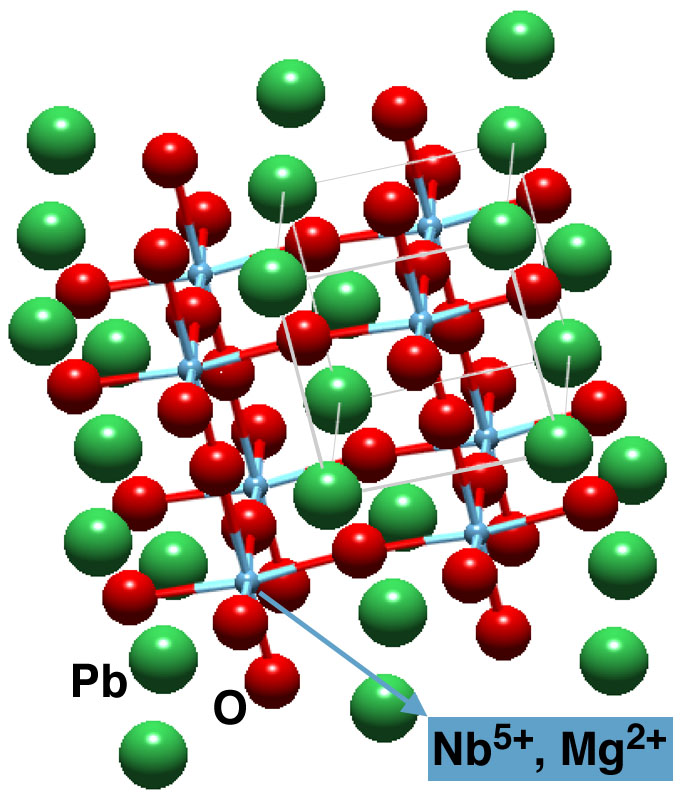
We consider here the perovskites Pb(Zn1/3Nb2/3)O3 (PZN) and Pb(Mg1/3Nb2/3)O3 (PMN) and their solid solutions with PbTiO3. They have an average ABO3 perovskite structure perturbed by occupational disorder on B-site positions.
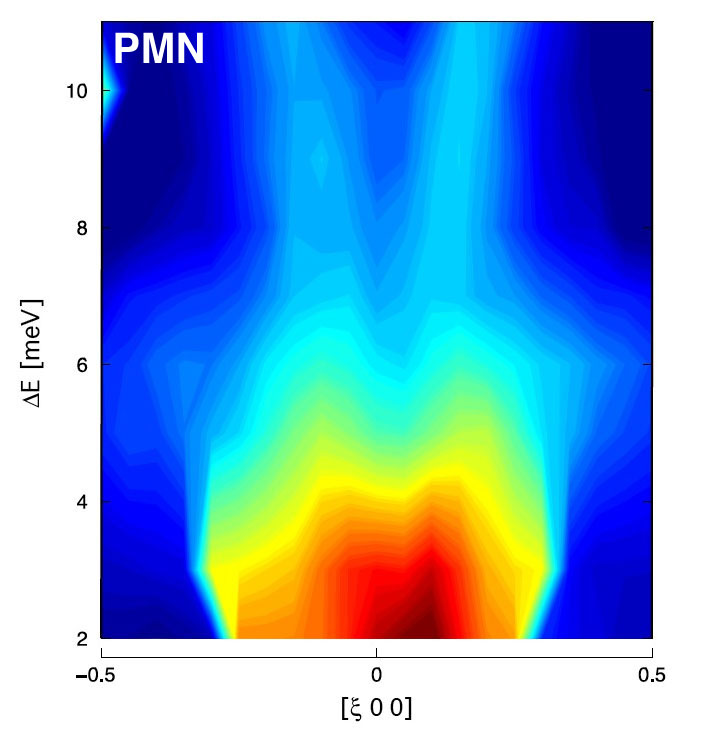
FlatCone made it possible to examine both there "waterfall" anomaly and elastic diffuse scattering at several temperatures.
1- the “Waterfall” anomaly
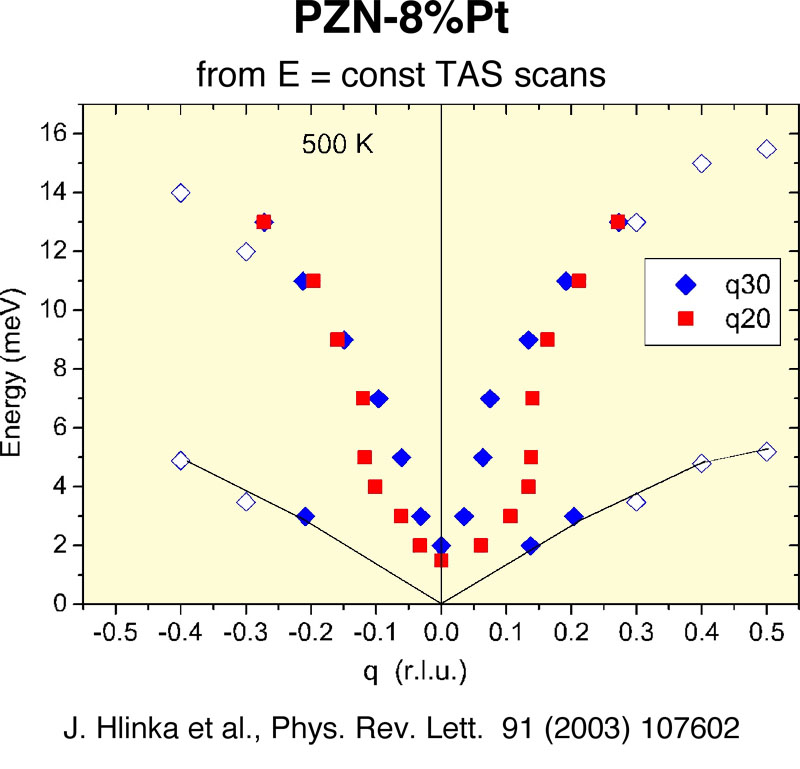
One of the characteristic features of the lattice dynamics of relaxor ferroelectrics is the so-called "Waterfall" anomaly with apparent vertical dispersion of low lying acoustic/optic phonon branches, first observed in the PZN-8%PT system by P. M. Gehring, S. E. Park & G. Shirane, Phys. Rev. Lett. 84 (2000) 5216.
The existence of an analogous feature in the PMN system has been subject to controversial discussion, but the FlatCone data provide an evidence for it.
2- Diffuse scattering due to short-range ordering
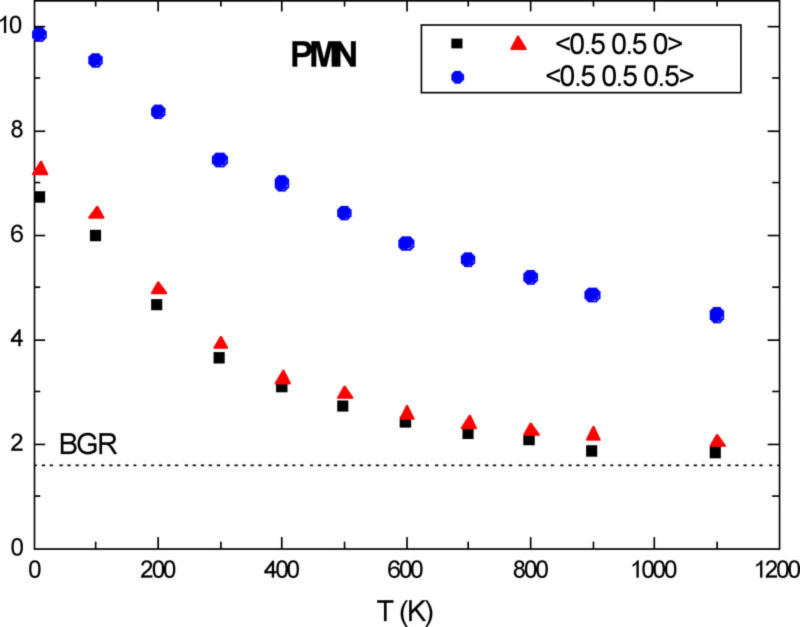
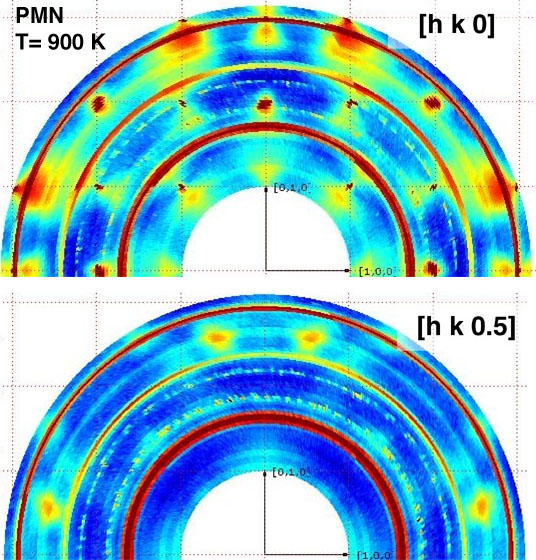
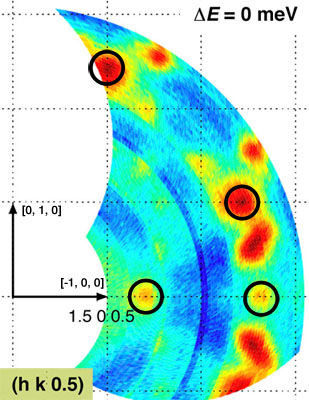
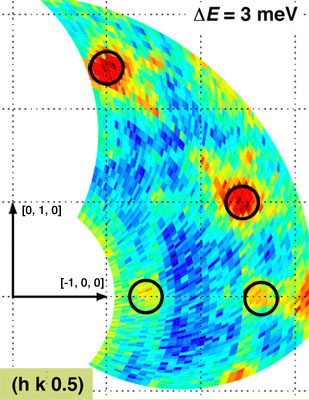
The flat-cone geometry with the tilted multianalyzer configuration permits systematic investigation of superlattice peaks having a momentum offset with respect to the equatorial plane. The (h k 0.5) plane displays two famillies of correlations: the <0.5 0.5 0.5> exhibiting more static features (presumably due to chemical short-range order) and the <0.5 0.5 0 > appearing only at lower temperatures and exhibiting a strong inelastic componenets and a temperature dependence close to the relaxor order parameter.
PMN up to 1100 K
FlatCone made it possible to measure the integrated intensity of the two types of satellites in the temperature range 4 K to 1100 K.