
How it works
From neutron source to detector in a high-filed configuration
Neutrons from the reactor are moderated in the graphite hot source so that the maximum flux is at a short wavelength.
- Hot neutrons enter beam tube H4 and go to the polarising monochromator which diffracts only neutrons with a given wavelength and spin polarisation.
- The guide-field maintains the polarisation state of this beam.
- The cryoflipper reverses alternately the polarisation state of the beam.
- The sample - a ferromagnetic or paramagnetic single crystal - is in a magnetic field and is cooled down or warmed up in a cryostat.
- For each Bragg reflection, the peak intensity depends on each polarisation state of the beam. A Fourier component of the magnetisation distribution in the crystal is obtained from the two intensities.
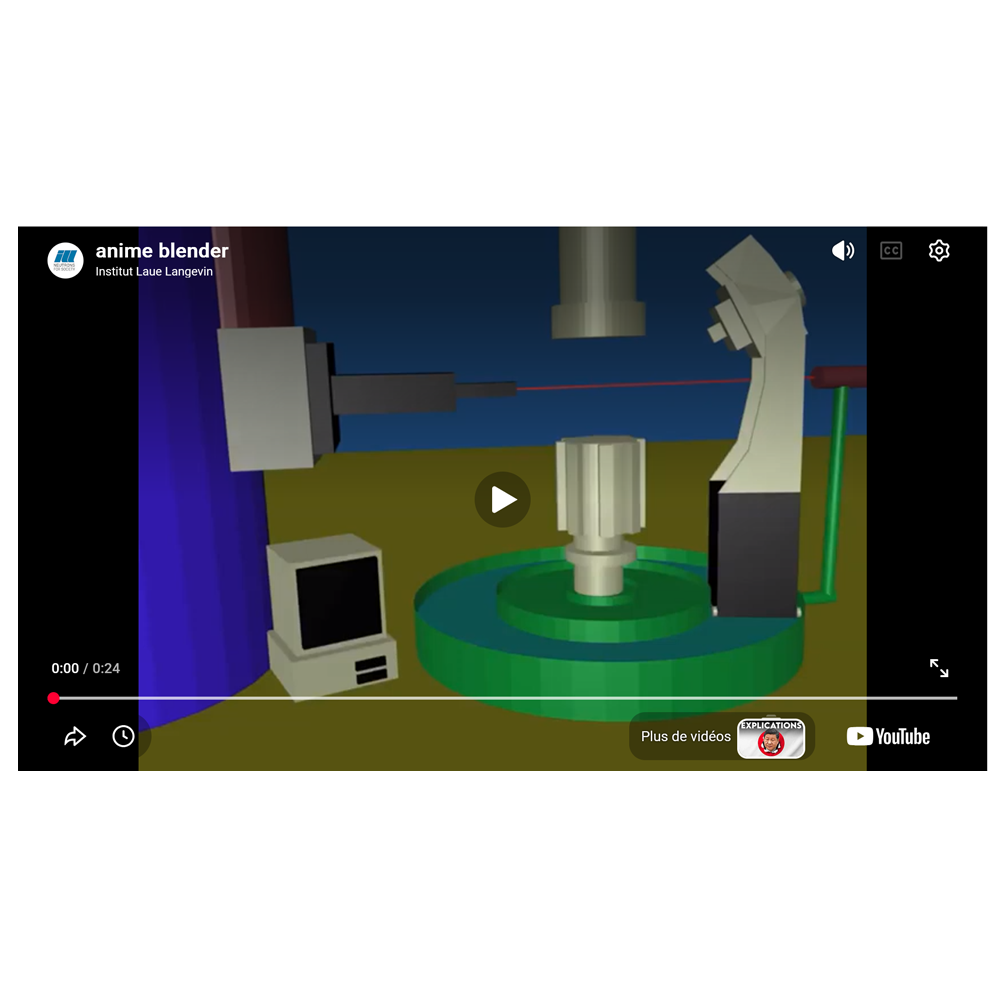
D3 is a polarised hot-neutron diffractometer
- The sample is lowered through the variable temperature insert of the cryomagnet into the beam.
- It is rotated so that a given set of crystal planes diffracts the beam.
- The detector is rotated and lifted towards the diffracted beam.
- The magnetisation distribution shown in the corner is derived from the ratio of the intensities measured with the two polarisations.
Measuring with polarised neutrons in a high magnetic field configuration
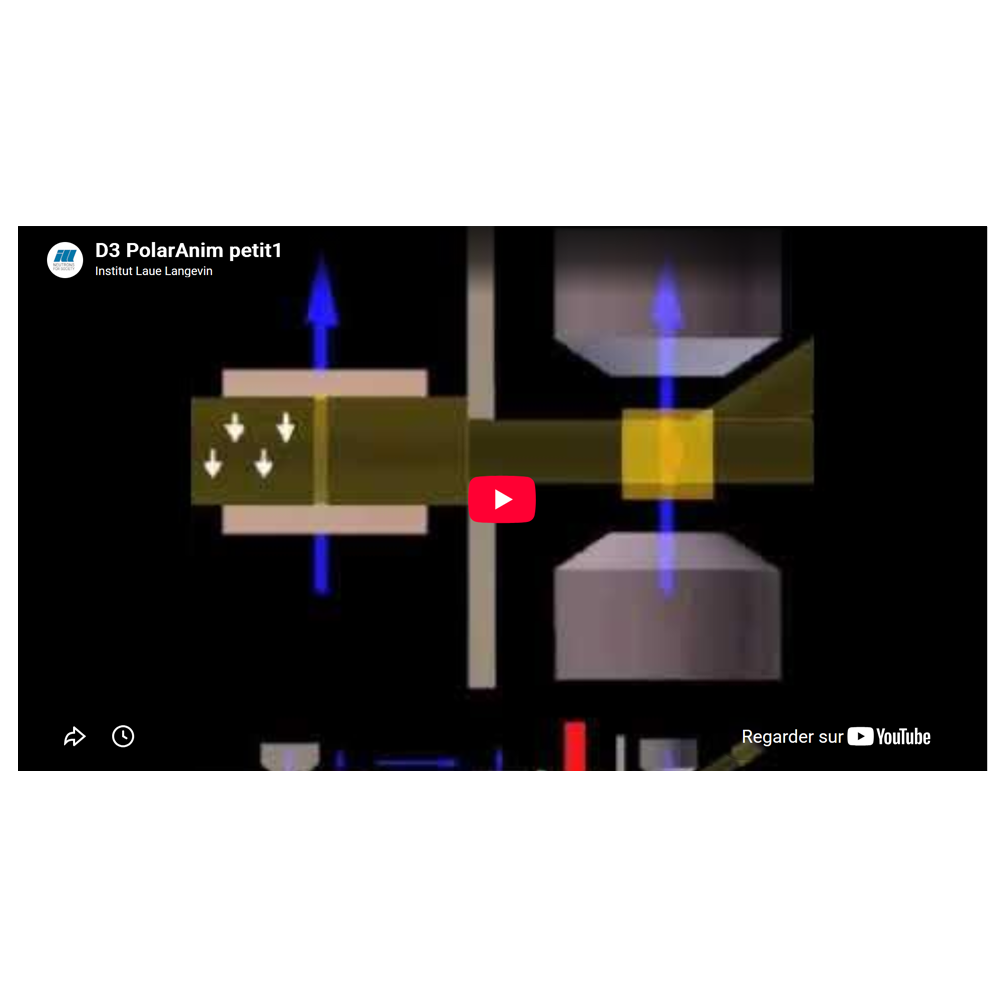
- The unpolarised neutron beam coming from the hot source enters the monochromator area.
- Under an applied magnetic field, the polarising monochromator diffracts neutrons having a given energy and polarisation sign.
- Guide-fields are used to maintain the polarisation of the beam. The educated viewer of the animation will notice an error in the direction of the magnetic guide-field when neutrons arrive at the Meissner Niobium foil. Up to that point the neutron spins follow adiabatically the magnetic guide field. As neutron spins are shown down the magnetic field must be down ”
- At the entrance of the cryoflipper, before the superconducting foil, the magnetic field is set parallel or anti-parallel to the field applied after the foil. The polarisation rotates adiabatically and crosses the foil.
- At the exit, the polarisation is parallel or antiparallel to the guide field.
- A slit reduces the size of the beam to lower the background.
- The sample, placed in an applied magnetic field, diffracts neutrons which are counted by the detector. The intensity of the diffracted beam depends on the initial polarisation of the beam.
Spherical polarimetry with CRYOPAD
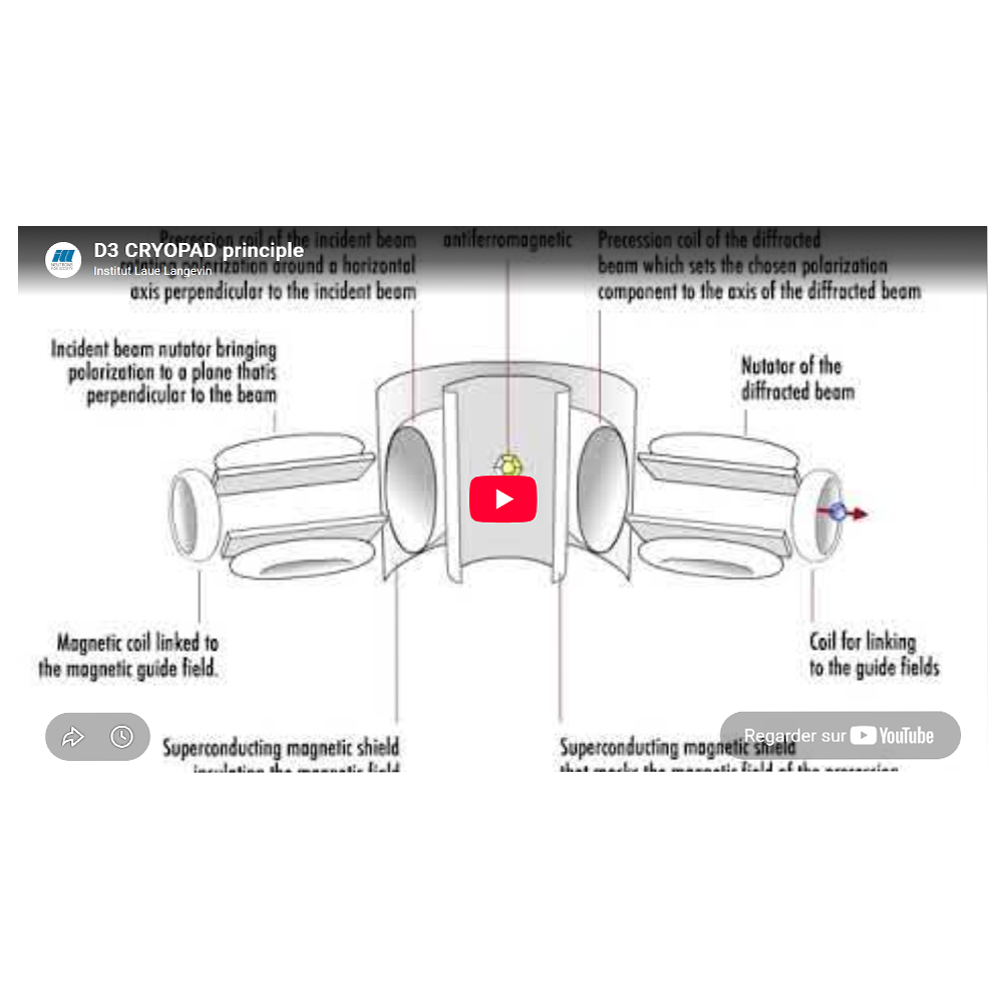
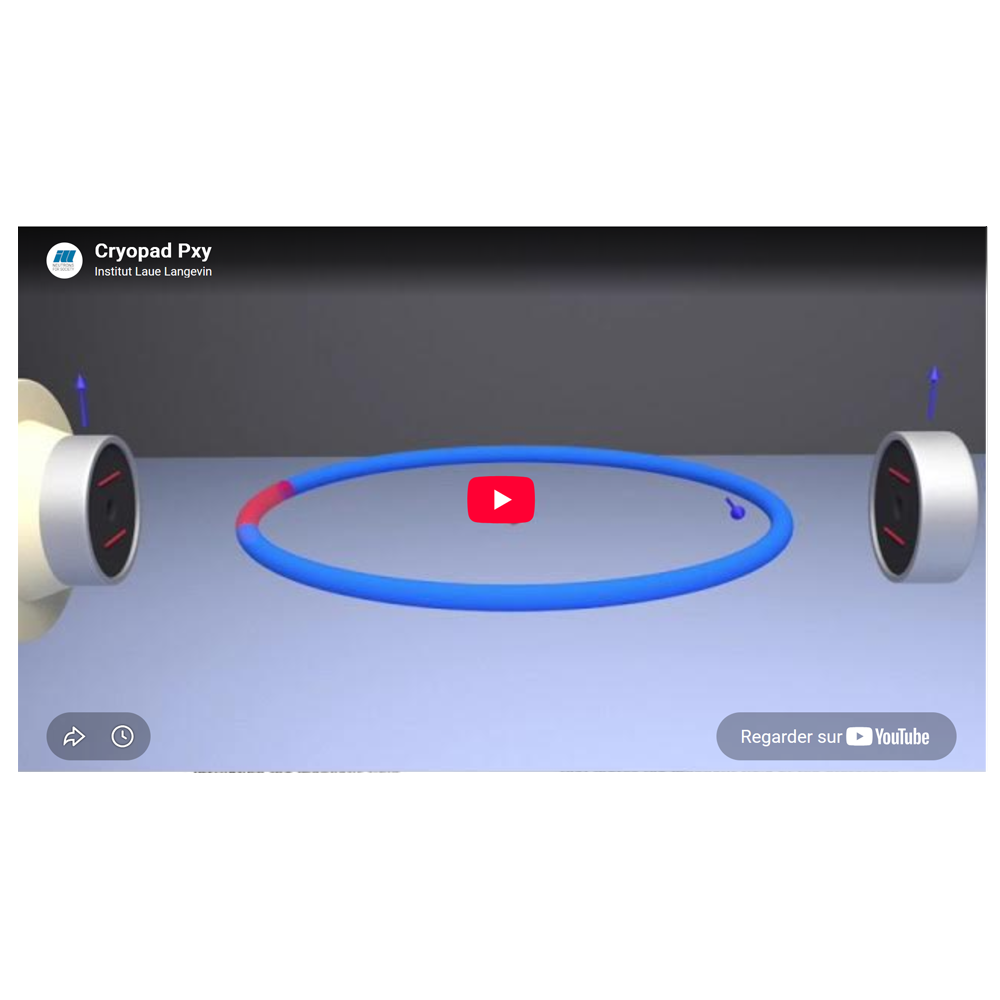
These movies show the adventures of neutron polarization during the passage through CRYOPAD and the sample. CRYOPAD is the acronym for “CRYOgenic Polarization Analysis Device”. The sample is in its center, in a magnetic field free zone created by a superconducting enclosure. Two sets of fixed and mobile coils make it possible to manipulate the direction of the neutron polarization vector at will, before and after the sample.
In the first video the scattered beam polarization vector is antiparrallel to the input polarization which means that the polarization rotates inside the sample by 180º around the magnetic interaction vector, which is true for collinear antiferromagnetic samples. Other kinds of magnetic samples modifies the beam polarization in a much complex way and this rotation is accurately measured by suitable precessions in the coils and rotations of the nutators.
In the second video the polarization axis of the incoming neutrons is set along the local x-axis, which is parallel to the scattering vector. In this example the rotation around the magnetic interaction vector creates a y-component (shown in green). In order to analyze this y-component it is guided along the neutron path until it reaches the He3 cell where the analysis axis is parallel to the direction of travel.
How it works
How it works
D3 CRYOPAD principle
D3 CRYOPAD principle
References
- Tasset, F., Brown, P.J. et Forsyth J.B. (1988) J. Appl. Phys. 63, 3606-3608.
- Tasset F. (1989) Physica B, 156-157, 627-630.