
Characteristics
| Reactor hall, thermal beam H11 |
|---|
| Monochromator | |
|---|---|
| 15 Ge [335] crystals of 5x2x1 cm3 | |
| take-off-angle | 135° |
| Germanium [hkl] | wavelengths λ /Å |
| 557 | 1.051 |
| 337 | 1.277 |
| 551 | 1.464 |
| 335 | 1.594 (optimum λ) |
| 331 | 2.398 |
| 113 | 3.152 |
| flux at sample λ = 1.594 Å | 1.06 Å high-resolution / 1.07 Å high-intensity |
| Sample | |
|---|---|
| beam size at sample | 2 x 5 cm\(^{2}\) |
| angular range | 0° <2θ <160° |
| 0° <ω <360° | |
| Detectors | |
|---|---|
| 1283He counting tubes | |
| background without sample | 0.1 Hz |
| Sample environment | |
|---|---|
| cryostat | 1.5 to 300 K |
| cryofurnace | 1.5 to 525 K |
| furnace | 200 to1000 K |
| cryomagnet | up to 6T and from 1.5K to 300K |
| dilution cryostat | 50 to 4000 mK |
| pressure cell | 2 GPa and 4 to 300 K |
| cryocooler | 3.5 to 700 K |
Technical description
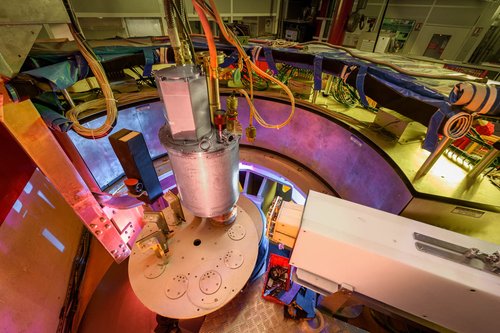
The diffractometer D2B is characterised by the very high take-off angle (135°) for the monochromator, which has a relatively large mosaic spread of 20' to compensate for the corresponding intensity (Δl/l) loss. It is 300 mm high, focusing vertically onto about 50 mm; this large incident vertical divergence is matched by 200 mm high detectors and collimators. A complete diffraction pattern is obtained after about 25 steps of 0.05° in 2θ, since the 128 detectors are spaced at 1.25° intervals. Such scans take typically 30 minutes; they are repeated to improve statistics. Apart from the work on superconductors, D2B is particularly well suited for the Rietveld refinement of relatively large structures, such as zeolites with absorbed molecules. It has as well proved successful for the solution of some of the new 'quasi-crystalline' materials. With the new 2D-detector, the efficiency of D2B has increased by an order of magnitude, and it is now possible to measure very small samples of about 200 mg with high resolution. D2B was also designed for work on magnetism and high resolution of very large d-spacings. Wavelengths can easily be changed under computer control, since they are all obtained by a simple rotation within the Ge[hhl] plane. A large graphite filter can be switched in to provide a very clean beam at 2.4 Å.
| Technical description |
|---|
| The diffractometer D2B is characterised by the very high take-off angle (135°) for the monochromator, which has a relatively large mosaic spread of 20' to compensate for the corresponding intensity (Δl/l) loss. It is 300 mm high, focusing vertically onto about 50 mm; this large incident vertical divergence is matched by 200 mm high detectors and collimators. A complete diffraction pattern is obtained after about 25 steps of 0.05° in 2θ, since the 128 detectors are spaced at 1.25° intervals. Such scans take typically 30 minutes; they are repeated to improve statistics. Apart from the work on superconductors, D2B is particularly well suited for the Rietveld refinement of relatively large structures, such as zeolites with absorbed molecules. It has as well proved successful for the solution of some of the new 'quasi-crystalline' materials. With the new 2D-detector, the efficiency of D2B has increased by an order of magnitude, and it is now possible to measure very small samples of about 200 mg with high resolution. D2B was also designed for work on magnetism and high resolution of very large d-spacings. Wavelengths can easily be changed under computer control, since they are all obtained by a simple rotation within the Ge[hhl] plane. A large graphite filter can be switched in to provide a very clean beam at 2.4 Å. |