
Characteristics
| D16 - Cold neutron diffractometer | |
|---|---|
| horizontal cold source | |
| beam tube | H5 |
| neutron guide | H521 (150 x 60 mm\(^{2}\)) |
| Focussing PG monochromator | |
|---|---|
| 9 vertically bending HOPG(002) crystals d = 3.355 Å or 3 Rb-intercalated graphite crystals | |
| area per element | 17 x 80 mm\(^{2}\) |
| total area | 150 x 60 mm\(^{2}\) |
| wavelengths (take off) | 4.5 Å and 7.5 Å (85°)5.6 Å and 9 Å (115°) |
| mosaicity | 0.4° (HOPG) and 1.5° (Rb-int) |
| Beryllium filter | |
|---|---|
| cooling | liquid nitrogen |
| cut-off | 3.95 Å |
| path length | 100 mm |
| efficiency | λ/2 < 0.1 % |
| Collimation | |
|---|---|
| 2 variable slits: | |
| S1 (mono) | max. 150 x 40 mm\(^{2}\) |
| S2 (sample) | max. 150 x 40 mm\(^{2}\) |
| monochromator-to-sample distance | 2.8 m |
| Sample area | |
|---|---|
| max flux at sample | 2x10n\(^{7}\)cm\(^{-2}\)s\(^{-2}\) |
| typical sample shape and size | cylindrical 30 x 10 mm\(^{2}\) (diffraction & WANS)flat 10 x 7 mm\(^{2}\) (SANS) |
| He detector (new trench detector as of 2023) | |
|---|---|
| distance | 1150 mm (detector radius of curvature) |
| angular range, rotation | 86° hor. 19° vert., -5° < 2Θ < 90° |
| detection area | 1728 x 380 mm\(^{2}\) |
| pixel size (hor. x vert.), number of linesnumber of pixelspixel resolution | 1.5 x 2 mm\(^{2}\), 1152 vert. x 192 hor.221,1840.075° hor., 0.1° vert. |
| max. counting rate | 500 kHz (less than 1% dead time) |
| beamstop | variable size, typically 32 x 20 mm\(^{2}\)X/Y motorized |
| 2-circle mode | |
|---|---|
| sample rotation (Θ) | -180° ... +180° +/- 0.001° |
| detector rotation (2Θ) | -5° ... +90° +/- 0.01° |
| 4-circle mode | |
|---|---|
| sample rotation (Θ) | -180° ... +180° |
| sample rotation (φ) | -180° ... +180° |
| sample rotation (χ) | -180° ... +180° |
The instrument
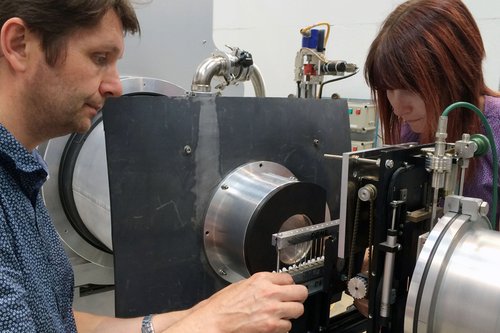
D16 is a recently upgraded two- or four-circle cold-neutron diffractometer used for the charaterisation of length scales in the nanometer range in soft condensed matter, biology and materials science.
Its original specifications were defined for the study of structures of a few nm periodicity diffracting to a real space resolution of a fraction of nanometer, making it perfectly suited to membrane diffraction studies, as were the first "biological membrane diffractometers" built in Brookhaven and Harwell in the early seventies.
The new instrument was commissionned in 2023 after a major upgrade that consisted in the replacement of the former detector (MilAND) by a large curved position sensitive 2D MWPC based on the new trench technology developped at ILL [1]. New granit platform, detector table and He flight chamber were part of this upgrade. New precision slits in the casemate and at the sample have also been installed. The significant increase in the solid angle of detection represents a 5-fold gain compared with the previous instrument. Detector scans are no longer required, since most experiments can now be carried out in a single detector position, resulting in dynamic q ranges of 0.02 - 1 Å-1 with the detector centred (SANS setup with beamstop) and 0.02 - 2 Å-1 with the detector positioned off the direct beam (SANS-WANS setup). The q-max remains unchanged at 2.5 Å-1 and can be reached by collecting data at a second detector position.
Because of its special characteristics, D16 remains unequalled for the study of a wide range of systems in biology, physics and physical chemistry. These include natural lipid membrane mutlilayers (thylakoids, myelin, skin lipids), model membrane multilayers, clays, colloidal structures, nanoporous materials, ionic liquids, (semi-)cystalline polymers.
The primary white beam is reflected by a focussing monochromator made of 9 highly oriented pyrolytic graphite (HOPG) providing an important flux at the sample. The monochromator housing has two beam holes at take-off angles of 85° and 115°, corresponding to 4.5 Å and 5.6 Å beams with HOPG and incorporates the slit systems and cooled Beryllium filter in a way that optimises the beam optics within space and health physics constraints.
The sample environment includes 3 identical humidity chambers [2], cryostats, furnaces, magnets, cryomagnets, high pressure cryostats, high pressure cells and an automatically positioned, temperature controlled horizontal sample changer.
In terms of Q-space and Q-resolution, D16 covers from the SANS to sub-nanometer ranges.
[1] Development of a large-area curved Trench-MWPC 3He detector for the D16 neutron diffractometer at the ILL
Jean-Claude Buffet, Viviana Cristiglio, Sylvain Cuccaro, Bruno Demé, Bruno Guérard, Julien Marchal, Jérôme Pentenero, Nicolas Sartor, and Jules Turi, EPJ Web of Conferences 286, 03010 (2023)
[2] BerILL: The ultimate humidity chamber for neutron scattering
Julien Gonthier, Matthew A. Barrett, Olivier Aguettaz, Simon Baudoin, Eric Bourgeat-Lami, Bruno Demé, Nico Grimm, Thomas Hauß, Klaus Kiefer, Eddy Lelièvre-Berna, Adrian Perkins and Dirk Wallacher, Journal of Neutron Research 21 (2019) 65–76