This website is being migrated. In case you don't find the information you are looking for, the old website can be found here. Thank you for reporting any anomalies to communication@ill.eu.

ILL at a glance

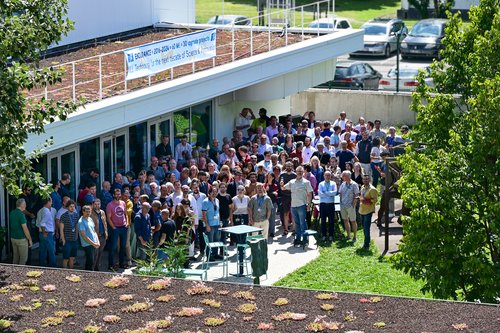
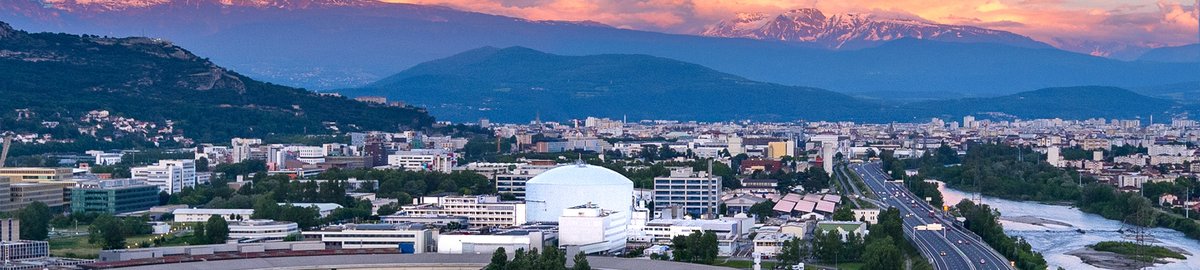
ILL Aerial 02

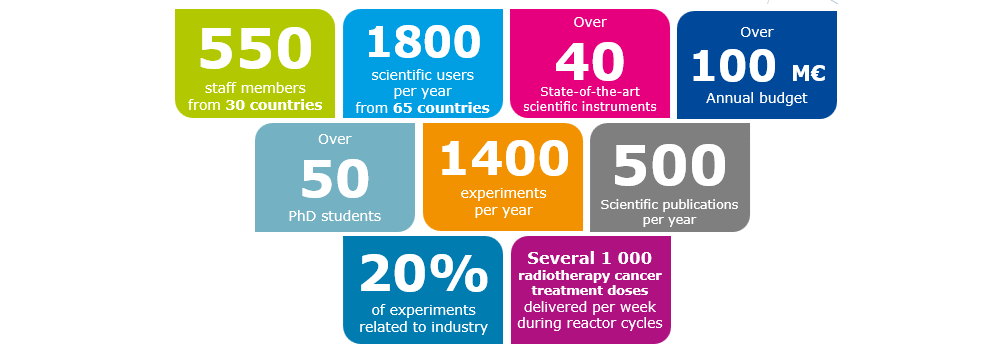
The Institut Laue-Langevin is an international research centre at the leading edge of neutron science and technology, offering researchers an exceptionally high neutron flux through around 40 state-of-the-art instruments that are constantly being developed and upgraded. As a service institute, the ILL makes its facilities and expertise available to visiting scientists. Every year, about 1800 researchers from over 65 countries visit the ILL and more than 1400 experiments selected by a scientific review committee are performed.

About 60% of the research at ILL focuses on fundamental science in fields such as condensed matter physics, chemistry, biology, nuclear physics, and materials science. The remaining 40% is dedicated to directly addressing modern societal challenges, namely in health, energy, the environment, and information technologies. For example, research is being conducted to explore how nuclear medicine can contribute to the fight against cancer and to develop new materials that can help meet tomorrow’s energy challenges or new technologies to reduce greenhouse gas emissions.

Whilst some researchers are working on battery design, fuels and catalysts, plastics and pharmaceuticals, others are looking at biological processes at cellular and molecular level. Still others may be elucidating the physics that could contribute to the electronic devices of the future. In particular, the ILL can tailor its neutron beams to probe the fundamental processes that help to explain how our universe came into being, why it looks the way it does today and how it can sustain life. 

The ILL also collaborates closely and at different levels of confidentiality with the R&D departments of industrial companies. All the scientists at the ILL - chemists, physicists, biologists, crystallographers, specialists in magnetism and nuclear physics - are also experts in neutron research and technology and their combined know-how is made available to the scientific community.

European flag

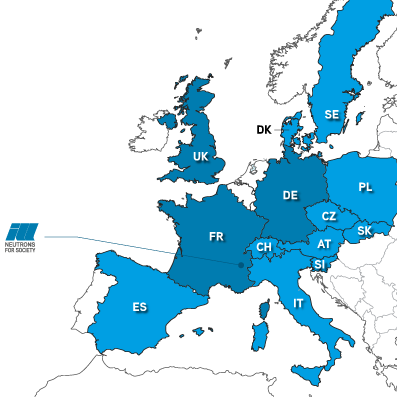
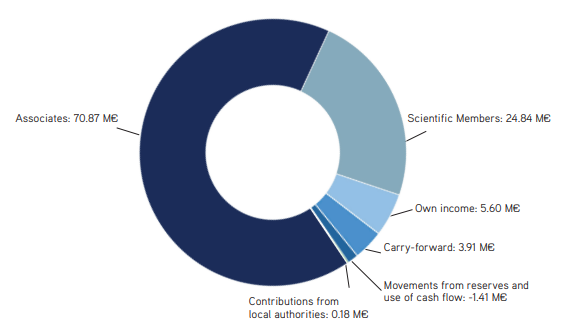
Funded and managed by France, Germany and the United Kingdom, and in scientific partnership with 10 other countries, ILL is located in a dynamic and scientifically rich city of Grenoble, nestled in the foothills of the French Alps.

The Institute is primarily a research facility for visiting scientists. However, general public visitors may access the site for guided tours for specific groups, or during public events and conferences. Access is also possible through partnerships or collaborative research projects with the Institute. For further details on visiting the ILL, please refer to this page.

ILL's mission: neutrons for society

The ILL's Mission is contained the tagline NEUTRONS FOR SOCIETY: to deliver excellent and impactful science, technology, innovation, and training, maximising its contribution to tackling the great societal challenges of today.

As a service facility, the ILL provides the international scientific community with the brightest neutron beams in the world, a state-of-the-art suite of instruments and support facilities, and the unique expertise of its scientists, engineers and technicians. Indeed, the ILL remains a cornerstone of the European neutron ecosystem.

Associates and Scientific Members

The ILL was founded in Grenoble in 1967 by France and Germany, joined a few years later by the UK. These are ILL's three Associate countries. Today, 10 additional Scientific Member countries fund the ILL for the benefit of their research communities. More infos.

/

ILL Organisation

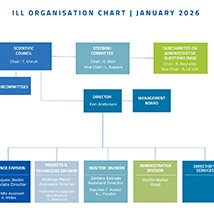
The ILL is led by a Director and two Associate Directors representing the Institute’s three Associate countries in rotating roles. Chaired by the ILL Director, the ILL Management Board ensures the efficient operation of the facility, in particular the collaboration and communication between the Divisions. The Steering Committee is the governing body of the Institute. Representing the Associate countries, it establishes the general operational and investment strategies and takes the important policy decisions concerning the future. The Scientific Council, composed of representatives of the Associate and Scientific Member countries, advises the ILL Management Board on scientific matters, in particular regarding scientific priorities and the development of the infrastructure in the interest of the user programme. It also assesses the scientific output of the facility. More infos.
/

The ILL is part of many local, national, and international networks and partnerships. The facility shares the European Photon and Neutron Science (EPN) Campus in Grenoble with European Synchrotron Radiation Facility (ESRF), the European Molecular Biology Laboratory (EMBL) and the Institute for Structural Biology (IBS). Together, they constitute a hub of excellence that created partneships and collaborations such as the Partnership for Structural Biology (PSB), the Partnership for Soft Condensed Matter (PSCM) and several industrial research collaborations. In Grenoble, the ILL  is also member of the GIANT network and partner of the Grenoble Alpes University (UGA).

At international level, the ILL is  a member of EIROforum, the European Intergovernmental Research Organisation forum, that brings together Europe’s largest research organisations. The ILL is also a founding member of LENS, the League of advanced European Neutron Sources

White square 50
Related pages
Page
Associates and Scientific Members
The ILL was founded in Grenoble in 1967 by France and Germany, joined a few years later by the UK. These are ILL's three Associate countries. Today, 10 additional Scientific Member countries fund the ILL for the benefit of their research communities. ASSOCIATE COUNTRIESFrance, Germany and …
Page
ILL Organisation
ILL Management structure ILL internal organisation The Management BoardThe ILL Management Board is chaired by th…
Page
ILL in the media
Recent articles 20252 March - L'Usine Nouvelle : ‘Collaboration with industry leads to better research’, says Richard Davies, a scientist at the Institut Laue-Langevin. (in French) 5 March - SciTechDaily : Where Does the Periodic Table End? Scientists “Milk” Atoms To Unveil Heavy Element Mysteries1…
Page
ILL Booklets & Brochures
Booklets The Institut Laue-Langevin (2024) 🇬🇧 The ILL general brochure gives an overview of…
Page
ILL virtual tour
Launch the ILL Virtual visit (version 2026) Enjoy 360° panoramas from more than 50 …
Page
ILL FAQ
What is the ILL's mission? The ILL is a service facility. Its purpose is to provide the international scientific community with the brightest beams of neutrons possible.Most of its neut…
Page
Founders and pioneers
The patrons When the French and German governments were seeking a name for the Institute in the 1960s, they decided to honour French and German scientists distinguished for their co…
Page
Techniques
The following pages describe the evolution of techniques at the ILL. Many of the latter were initiated at the ILL but testimonials, photos or documents are often rare, at least for the first 30 years of the ILL. Understanding how we arrived at current techniques is instructive and it is useful to d…
Page
Prizes and honours
On this page, we present some of the famous (and not so famous) prize-winning scientists who have worked at or collaborated with the ILL over the years. This is by no means an exhaustive list but should give you some idea of the sheer wealth of ground-breaking research to which the ILL and its neut…
Page
Contact the ILL CFS Officer
Reminder of the legislation concerning whistleblowersTo be considered a whistleblower under the law and benefit from the associated protection regime, one must:- meet the definition of a whistleblower, meaning that:the whistleblower is a natural person, i.e., they are not making the report as a com…