
Can concrete waste help store CO₂?
29 Jun 2026Operando neutron and X-ray tomography reveal how water transport and cracking shape carbonation in cement paste
-
 Environment

The construction sector faces two problems at once: it emits large amounts of CO₂ and produces vast quantities of concrete waste. But what if part of that waste could be used to trap carbon instead of ending up as rubble?
That is the idea behind accelerated carbonation.
Crushed recycled concrete can be exposed to CO₂-rich gas, allowing carbon dioxide to react with the old cement paste and become locked into stable mineral compounds. In principle, this could help reduce the environmental impact of construction while giving demolition waste a second life.
The challenge is that concrete does not behave like a simple sponge for CO₂. Inside the material, the reaction depends on a fragile balance between gas, water, pores and minerals. If the pores are too dry, carbonation slows. If they contain too much water, CO₂ struggles to move through them.
At the ILL, researchers used neutron imaging on NeXT to follow water inside cement paste during carbonation, while X-rays tracked structural changes and cracking. This real-time view showed that carbonation actively reshapes the material as it progresses: it releases water, changes the pore network, slows CO₂ transport and creates cracks that later partly close.
The result is a clearer picture of what controls CO₂ storage in recycled concrete. This is an important step toward designing better carbonation treatments for recycled concrete and turning a major waste problem into a more circular route for lower-carbon construction.

A climate challenge with a solution hidden in plain sight
Concrete is everywhere: in buildings, roads, bridges, tunnels and almost every form of infrastructure. It is strong, versatile and relatively inexpensive, which explains why it is the second most consumed material in the world, after water.
Its environmental impact, however, is considerable. Cement production is responsible for 5–7% of global CO₂ emissions, due both to the energy needed to heat cement kilns to extremely high temperatures, but also from the raw material itself: limestone releases CO₂ when it is transformed during cement production.
Concrete also poses a major waste challenge. The construction sector is the largest contributor to global waste, and billions of tonnes of concrete are discarded every year when buildings and infrastructure are demolished. This waste could become a resource: between 2.8 and 5.1 gigatonnes of concrete may be available annually for reuse and potential CO₂ capture within a circular recycling framework.
This creates a double challenge: how can the construction sector reduce its carbon footprint, while also reusing the large quantities of concrete waste generated when buildings and infrastructure are demolished?
Accelerated carbonation of recycled concrete is one possible answer. Instead of treating old concrete only as waste, it can be crushed and reused as aggregate in new construction materials. Before reuse, these recycled aggregates can be exposed to CO₂-rich gas. The CO₂ reacts with the old cement paste attached to the aggregates and becomes stored in mineral form, mainly as calcium carbonate.
In principle, this approach could contribute to both emissions reduction and circularity: less waste sent to landfill, less demand for virgin aggregates, and part of the CO₂ emissions transformed into a stable solid inside the material.
The promise and complexity of accelerated carbonation
Carbonation is a natural reaction in cement-based materials: CO₂ from the air slowly penetrates concrete and reacts with some of the cement hydrates, forming calcium carbonate. Accelerated carbonation aims to speed up this process by exposing recycled concrete materials to CO₂-rich gas under controlled conditions.
This is especially interesting for recycled concrete aggregates. Unlike natural aggregates, they often carry a layer of old cement paste, which is more porous and reactive. That old paste is usually seen as a drawback because it can make recycled aggregates more absorbent and less predictable. But it also creates an opportunity: it provides both pathways for CO₂ to enter and mineral phases with which CO₂ can react.
The difficulty is that carbonation depends on a delicate balance. CO₂ must be able to move through the pore network, but the reaction also needs water to proceed. Too little water limits the chemical reaction; too much water blocks the pores and slows CO₂ transport. As carbonation progresses, the material itself changes, altering both moisture distribution and gas access.
This is why improving accelerated carbonation is not only a question of exposing concrete waste to more CO₂. It requires understanding how CO₂, water, mineral reactions and microstructural changes evolve together inside the material.
Neutrons reveal water’s role in CO₂ storage
To see these hidden processes, the researchers turned to a technique particularly sensitive to water inside materials: neutron imaging. Unlike many other imaging techniques, neutrons are highly sensitive to hydrogen. Since water contains hydrogen, neutron tomography can reveal where water is located inside cement-based materials and how it moves over time.
The experiments were carried out on NeXT, the neutron and X-ray tomography instrument at the ILL. To reproduce conditions relevant to accelerated carbonation in realistic industrial conditions, a dedicated experimental cell was used to expose cement paste samples to CO₂-rich gas at 80 °C while imaging them in real time.
The strength of the approach was to combine two complementary views of the same process. Neutron tomography followed the evolution of water inside the sample. X-ray tomography showed changes in density, the advance of the carbonation front and the formation of cracks. By acquiring both datasets simultaneously, the team could connect water movement, mineral transformation and mechanical damage in three dimensions and over time.
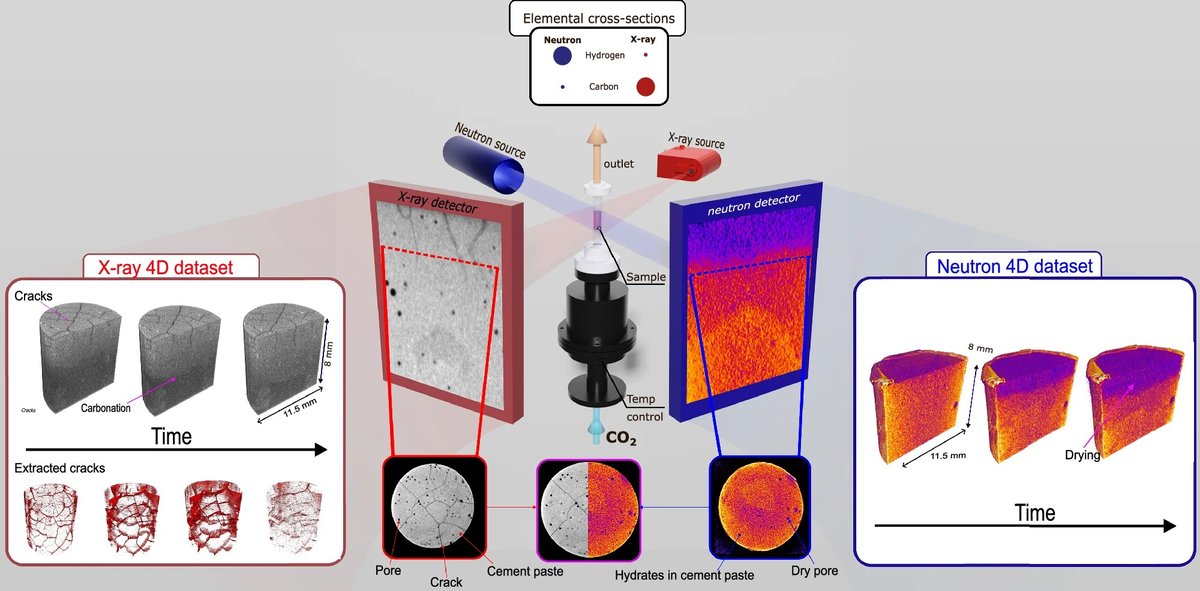
The NeXT instrument at the ILL combines X-ray and neutron imaging to observe the evolution of cement paste carbonate in real time: X-rays reveal cracks and structural changes, while neutrons track how water moves through the material. Credit: Communications Materials (2026).
This combined view revealed that carbonation is not a simple process in which CO₂ steadily diffuses into empty pores. As CO₂ reacts with hydrated cement phases, it releases water that was previously chemically bound inside the material. Neutron imaging showed that this water can accumulate and redistribute within the pore network, changing the conditions through which CO₂ must continue to move.
This has a direct effect on carbonation. At the beginning of the experiment, the carbonation front advanced in a way that resembled classical diffusion. But as the reaction progressed, the rate slowed down. The released water partly filled the pores, making it harder for CO₂ to move further into the material. In other words, the reaction changed the transport properties of the cement paste as it unfolded.
The second important observation was that the highest CO₂ uptake did not occur directly at the exposed surface, but slightly below it. The surface dried rapidly under the experimental conditions, which limited the carbonation reaction there. Slightly deeper in the sample, where enough water remained available, carbonation proceeded more effectively. This result illustrates why water is not just a by-product of carbonation, but one of the factors controlling how efficiently CO₂ can be stored.
The simultaneous X-ray data added another part of the picture. They showed that carbonation induced cracks in the cement paste, especially in the carbonated zone near the exposed surface. These cracks developed during the early stages of the experiment, reached a maximum volume, and then partially closed. When compared with the neutron water profiles, the crack evolution was strongly linked to changes in moisture inside the material.
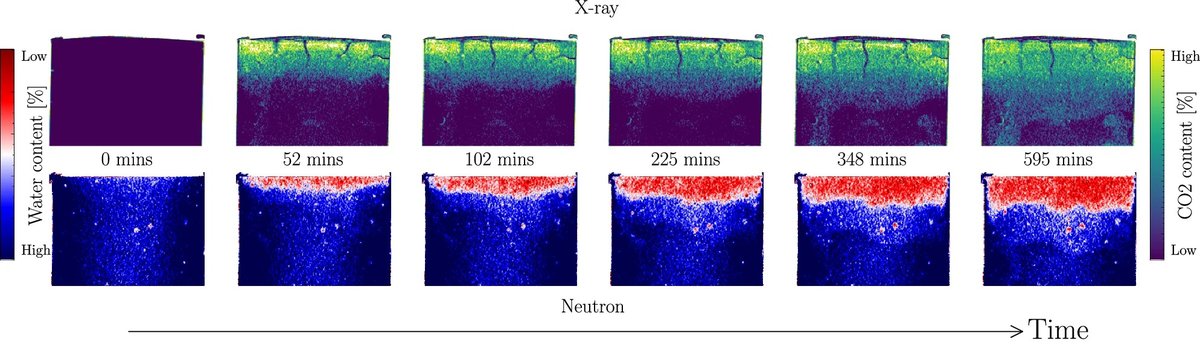
X-ray and neutron images reveal carbonation as it progresses through cement paste. X-rays, top row, show the advancing carbonation front, while neutrons, bottom row, track changes in water content. The comparison shows that carbonation slows over time as water released by the reaction fills pores and restricts CO₂ transport. Credit: Communications Materials (2026).
Together, these results show why simple diffusion-only models are not enough. Carbonation depends on a moving balance between CO₂ transport, water release, drying, mineral formation and cracking. Each of these processes affects the others. If models ignore this coupling, they risk overestimating how quickly carbonation can proceed or how much CO₂ can be stored.
Turning an environmental challenge into a circular solution
What makes this study powerful is that the researchers were able to watch carbonation while it was happening, rather than only measuring the material before and after treatment.
This was possible thanks to two developments at the ILL: a specially designed carbonation cell, able to reproduce hot, CO₂-rich conditions while remaining transparent to neutron and X-ray beams, and the unique 5D imaging capability of NeXT. Neutrons followed the water, while X-rays showed how the mineral structure and cracks evolved.
Together, they revealed a process that is far more dynamic than a simple flow of CO₂ into concrete waste. Water is released, pores change, cracks open and partly close, and all these effects influence how much CO₂ can be stored.
By making these hidden mechanisms visible, the study provides the knowledge needed to design better carbonation treatments for recycled concrete. This is an important step toward turning a major waste problem into a more circular route for lower-carbon construction.
Reference: C. El Faqir, A. Tengattini, B. Huet, M. Briffaut and S. Dal Pont, Operando 5D tomography uncovers carbonation-driven water transport and cracking in hydrated cement paste, Communications Materials, 7, 49, 2026. DOI: 10.1038/s43246-025-01060-2
ILL instrument: NeXT
ILL contact person: Alessandro Tengattini
Institutions involved in the research: Université Grenoble Alpes, Holcim Innovation Center, Institut Universitaire de France, LaMcube