Instrument Description
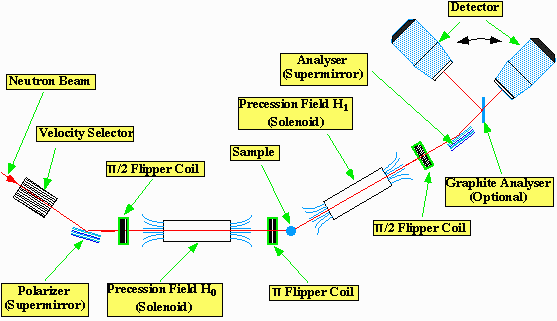
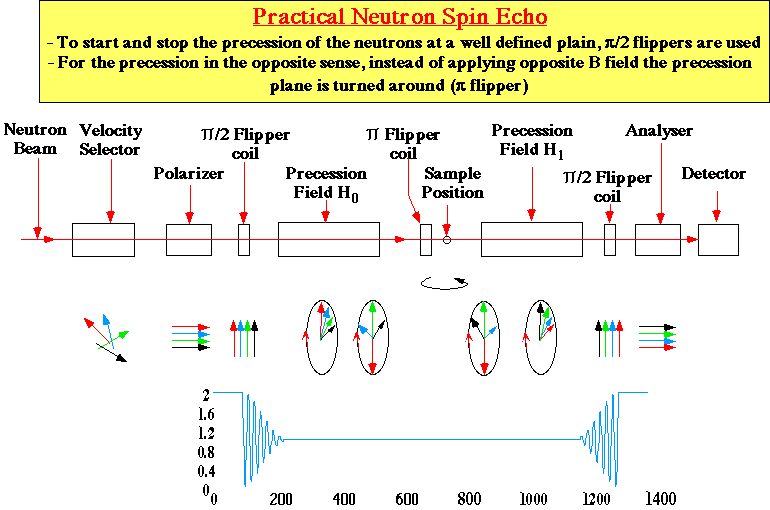
In a spin-echo experiment very high energy resolution is achieved by encoding the neutron energy into a Larmor precession angle: Polarized neutrons are sent through two anti-parallel magnetic fields before and after scattering from the sample. The precession angles in the two fields are equal and opposite, so that for elastic scattering full polarization is recovered, irrespective of the initial neutron velocity distribution. Small energy transfers lead to a change in the precession angle of the outgoing beam and, hence, to a decrease in the measured polarization. The intermediate scattering function S(Q,t)/S(Q,0) is directly determined by scanning the magnetic fields in the coils and measuring the polarization.
Two detector options are available for high Q/energy resolution and high signal, respectively. Option IN11A is a 2-dimensional multidetector with a pixel size of 5x5 mm2. Option IN11C with 41 detectors distributed over an angle of 30deg offers a count rate superior by a factor of 20 with the trade off of a lower energy resolution.
A polarization of 99% is created by supermirrors. They polarize and analyse the beam parallel to the beam direction. The polarization direction is turned perpendicular to the precession fields H0 and H1 in the solenoids by two pi/2-flipper coils. An additional pi-flipper coil allows keeping the fields H0 and H1 parallel resulting in higher polarization at small scattering angles.
The sample stage takes all ILL standard sample environments including orange cryostats, cryo-furnaces and 3He cryostats. A non-magnetic high temperature oven (300...780 K) is also available at IN11.