
D20 - High-intensity two-axis diffractometer with variable resolution
D20 is very high intensity 2-axis diffractometer equipped with a large microstrip detector. Due to the extremely high neutron flux, it opens up new possibilities for real-time experiments on very small samples.
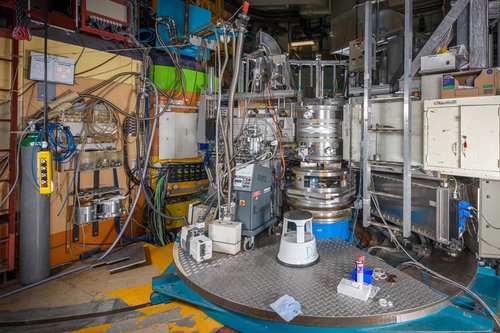
The complete diffraction pattern at 1536 positions, covering a scattering range of 153.6°, can be obtained in a matter of seconds, and followed as a function of temperature, pressure or other parameter. The variable monochromator take-off angle, up to 120°, increases the flexibility of the instrument, providing high resolution over the complete diffraction pattern at the highest take-off angle with a neutron flux of up to 107ns-1cm-2 or a high flux of up to 108ns-1cm-2 at medium resolution at lower take-off angle.
Applications
Thermodiffractometry | Magnetism | Kinetics | Multi-stroboscopy | Texture | Very small samples | Highly absorbing samples | Disordered systems | Physisorption
Position-sensitive multidetector
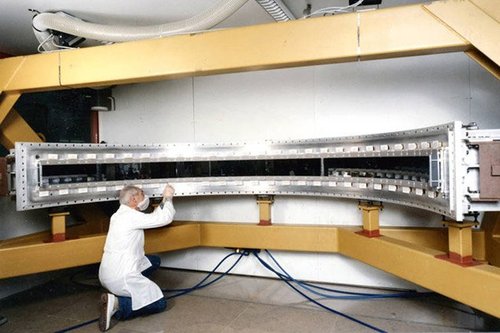
Assembly of the microstrip gas-chamber position sensitive detector (2000). The advantages of this technology are a very homogeneous response, a very high stability and the possibility of very high counting rates.
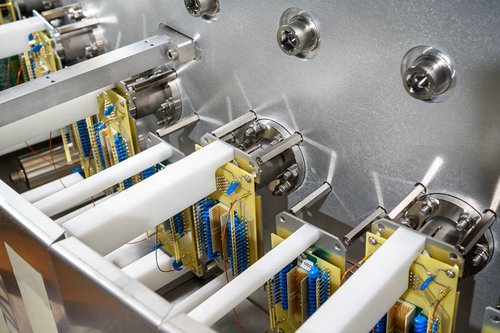
Micro-strip plates are made of chromium sputtered onto the polished surface of an electronically conducting glass. The chromium is etched to create conductive micro-strip electrodes (alternately 4 cathodes and 4 thin anodes per detection cell). The detection plates have each 32 cells of 2.568 mm (0.1˚) each, covering in total 3.2˚.
The current PSD covers 153.6˚, with 48 plates mounted in a curved aluminium housing providing a detection zone about 4 m long by 150 mm high.