Upward spiral for next-generation computing
06 Sep 2023Experimental evidence of rare magnetic behaviour in LiYbO2 will help to open the door to a new family of materials with potential applications in spintronics, quantum computing and more.
Though continuous down-scaling in microelectronics has enabled the industry to achieve phenomenal success, the trend is now approaching fundamental limits. Promising alternative technologies for next generation devices exploit not only the charge of the electron – as used in conventional microelectronics – but also the electron spin (spintronics) or spin waves (magnonics) in order to transmit, store and process information with improved energy efficiency, processing speed and memory storage density. Neutrons are a uniquely powerful probe for the advancement of these technologies due to the intrinsic spin of neutrons that provides them with a magnetic moment and thus the capability to reveal not only the atomic-level structure of materials but also the microscopic magnetic structure and dynamics. The Institut Laue-Langevin (ILL) is at the forefront of research in this area, contributing to and benefiting from the world-class magnetism expertise in Grenoble that can be traced back to Louis Néel, whose contributions to magnetism were acknowledged by a Nobel Prize.
For several decades, yttrium iron garnet (YIG) has been the prototypical material used to study and advance research in a variety of spintronic and magnonic domains. This essential material was discovered and its magnetic structure elucidated by Bertaut, Forrat and Néel, working in Grenoble in the 1950s. Neutron diffraction was subsequently used to verify the proposed models and provide a detailed description of YIG’s complex ferrimagnetic structure. “In common ferromagnetic materials, such as iron, the magnetic moments are aligned in the same direction creating a north and south pole,” explains Timothy Ziman, CNRS research director and member of the ILL Theory Group. “YIG, however, is composed of charged iron atoms caged within two structurally different types of interlocking crystal subunits. Overall net magnetisation is created by the 3:2 ratio of these subunits, with the iron ions collectively aligned but in opposite directions.”
Theory had long predicted that magnons propagating in a structurally complex ferrimagnet like YIG split into two branches with opposite polarisations and different energies. This magnon polarisation was explicitly demonstrated in YIG for the first time by an experiment successfully carried out on the polarised neutron inelastic scattering instrument – IN20 – at the ILL, with the results published in Physical Review Letters in 2020. [1] “IN20 is the uncontested best instrument worldwide to study the polarisation of magnons in the thermal energy range,” explains Mechthild Enderle, ILL scientist and first responsible for IN20. “The most original aspect of the experiment,” continues Ziman, “is that the chirality was visible not only near absolute zero temperature, as was expected, but even at room temperature, which could be hugely significant for potential future applications such as spintronics.”
The unique properties of YIG have ensured that it is a well-known and widely used material. In comparison, the other members of the rare-earth iron garnet series have currently very limited use. “It’s an incredibly flexible family of compounds, all chemically very similar and with essentially the same fairly open structure, where yttrium can be replaced by other rare-earths such as terbium, gadolinium, thulium or samarium,” explains Ziman. YIG, though complicated, is the simplest member of the rare-earth iron garnet series due to the fact that the yttrium ion has no magnetic moment, as opposed to the other rare-earth ions which each bear their own magnetic moments. Though the substitution of non-magnetic yttrium ions with magnetic rare-earth ions introduces an additional level of complexity, it is also responsible for interesting properties with strong potential applications. There has thus been a significant renewal of interest in the study of the spin structures and spin wave dynamics of the entire rare-earth iron garnet series.
Terbium iron garnet is one such example for which exploratory experimental data has been acquired at the ILL using IN20. “In terbium iron garnet, the terbium ions are pointing in one direction and the iron ions in the other direction but the overall net moment is dominated by terbium due to their much greater magnetisation, meaning that you’re starting with a ferrimagnet like YIG,” explains Ziman. “As the temperature increases though, terbium starts fluctuating up and down and its average moment gets smaller. At a certain point, referred to as the compensation temperature, the magnetisation moment of the terbium ions and iron ions are exactly balanced and essentially you have, at this one temperature, an antiferromagnet.”
Antiferromagnetism – where the magnetic moments in a material are of equal magnitude but aligned in opposite directions – was first proposed by Néel and later proved using neutrons. Today, antiferromagnets attract significant interest due to their promising applications in the field of spintronics-based magnetic memory. “Uniformly magnetised regions in magnetic materials are called domains and domain walls are the finite regions separating domains and over which the magnetisation rotates from one domain orientation to another,” explains Ziman. “A major challenge in magnetic memory is the speed at which domain walls can be moved and ultrafast domain wall motion has been observed in ferrimagnetic materials near a second compensation temperature at which the net angular momenta of the sublattices cancel.” The spin dynamics at and around the compensation temperatures is thus an active area of research.
It is expected that future polarised neutron inelastic scattering experiments on IN20 at the ILL will cover the entire series of rare-earth iron garnets in order to attain a full quantitative understanding of their spin-wave dynamics. In parallel, theoretical and experimental neutron diffraction studies continue to advance our understanding of the structures of these compounds, first elucidated in Grenoble in the 1950s. A recently published study has investigated the complicated umbrella-like spin structure of rare-earth iron garnets and how it changes with temperature. [2] “At low temperature, terbium iron garnet has three terbium ions which each point in different directions and together form a three-ribbed open umbrella structure. The ribs of the umbrella close, however, as the temperature is raised,” explains Ziman. The detailed information provided by such studies contributes to the interpretation of experimental observations, in addition to the guidance of future experimental work.
Just as a bar magnet has a magnetic dipole pointing south to north, the motion of electrons around a nucleus gives rise to an atomic-scale magnetic dipole. Inside a material, these atomic magnetic dipoles can arrange in different ways to give rise to magnetic properties.
Many data storage devices use ferromagnetic materials that have separate subregions (domains) within which magnetic dipoles are aligned in the same direction. Depending on whether the domain magnetisation is up or down, a corresponding data bit will have a value of either 1 or 0.
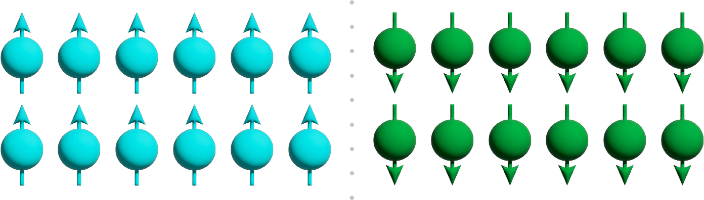
Logically, the smaller the ferromagnetic domains, the more densely information can be stored. However, very small domains are hard to create and read back, are more susceptible to environmental influences (such as heat) and, when packed closely together, their magnetic fields can interfere. All these factors increase the risk of errors.
With growing demand for smaller and more versatile devices, scientists are looking for new materials in which magnetic dipoles interact to give rise to unusual spin textures, such as knots and vortices. If these smaller spin structures can be reliably stabilised and manipulated, they could be used as information carriers in next-generation devices.
A spiral spin liquid is an enigmatic magnetic state in which spins fluctuate collectively as spirals. Although their existence has been predicted, experimentally, spiral spin liquids are rare because they are very sensitive to structural distortions, which trigger transitions to more conventional magnetic states.
Through a combination of high-resolution and diffuse neutron magnetic scattering studies, researchers from the University of Birmingham and Institut Laue Langevin (ILL) have measured the spiral spin liquid ground state in LiYbO2. This is the first time that this type of spin texture has been observed in an elongated diamond lattice, having only previously been realised in perfect diamond lattices.
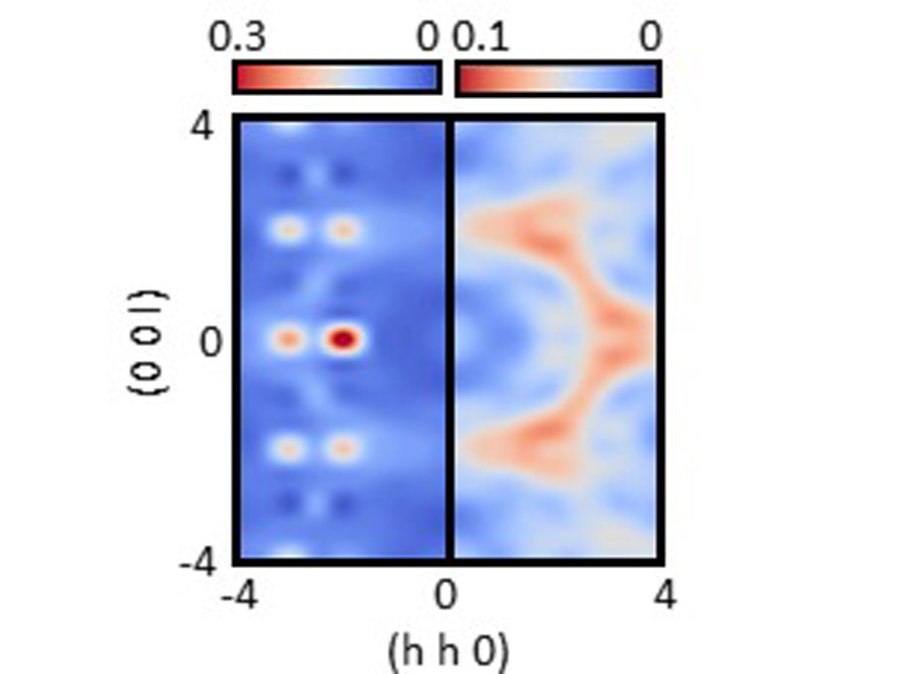
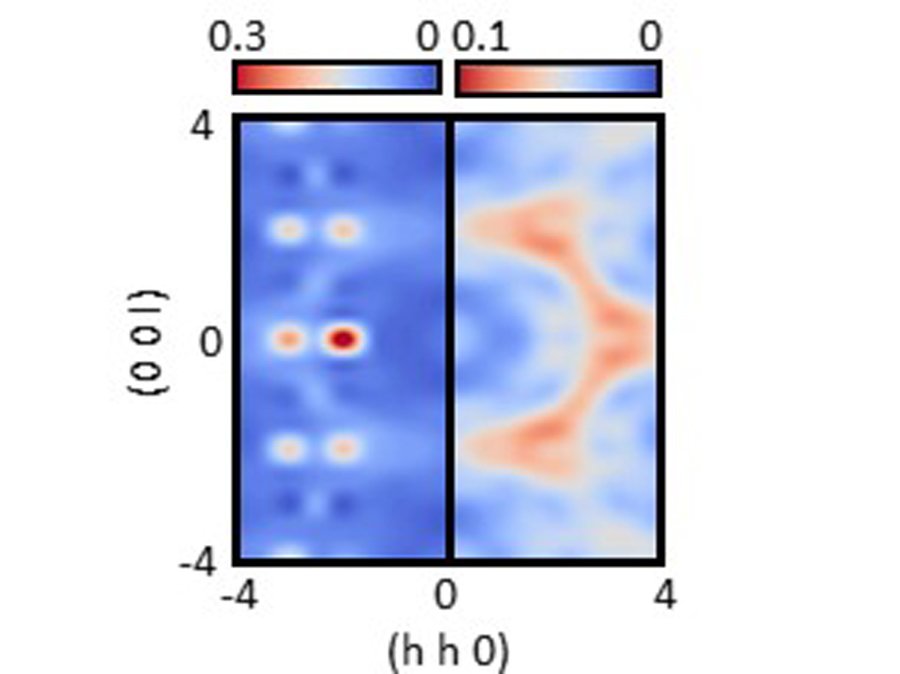
Using the WISH diffractometer at the ISIS Neutron and Muon Source, Graham et al. showed experimentally that LiYbO2 fulfils the average theoretical parameters of a spiral spin liquid phase. This was reinforced by complementary diffuse powder scattering studies on the D7 instrument at the ILL, from which it was possible to reconstruct single-crystal diffuse neutron magnetic scattering maps that reveal continuous spiral spin contours—an experimental hallmark of this exotic magnetic phase.
“Neutron scattering is the best tool that we have to be able to measure exotic magnetic phases, such as spiral spin liquids,” says Jennifer Graham, who led this work as part of a PhD research project co-funded by the University of Birmingham and ILL.
“What is interesting from an experimental perspective is that spiral spin liquids are partially ordered magnetic ground states - they have contributions arising from average and short-range magnetic exchange interactions - and therefore modelling systems like these are challenging. Our analysis of the D7 data, in which we simultaneously refined the average and short-range features of the data using reverse Monte Carlo analysis, is at the very forefront of the analysis possible on powder samples. This is important, as materials with partial magnetic order are becoming more prevalent in the field, and so understanding how to model systems like those with spiral spin liquid ground states are essential if quantum magnetic materials are to become functional in the future.”
In proving that the elongated diamond lattice structure of LiYbO2 can host a spiral spin liquid, these findings improve our fundamental understanding of magnetic phenomena and pave the way for the design of new magnetic systems with advanced technological applications.
ILL instruments used: D2B, the High-resolution two-axis diffractometer & D7, the Diffuse Scattering Spectrometer
Reference: Experimental Evidence for the Spiral Spin Liquid in LiYbO2, Phys. Rev. Lett. 130, 166703 – Published 21 April 2023 : https://doi.org/10.1103/PhysRevLett.130.166703
Using Mag2Pol