
Au coeur des pores
23 Jui 2026La combinaison de l'imagerie neutronique in situ et de modèles numériques ouvre la voie à un nouveau modèle de condensation de vapeur d'eau dans les matériaux poreux
-
 Environnement

Les molécules d'eau sont minuscules et elles se déplacent très rapidement à travers les matériaux, même ceux qui, à première vue, peuvent sembler imperméables. C'est le cas de nombreux matériaux poreux. Il est essentiel de comprendre comment l'eau se condense au sein des roches poreuses pour évaluer l'impact de ce phénomène sur les propriétés des matériaux, en vue de futures solutions de stockage souterrain.
Dans une étude récente combinant un nouveau modèle particulièrement complet de condensation de l'eau avec des données expérimentales obtenues sur le tomographe neutronique NeXT de l'ILL, les scientifiques ont pu obtenir une description très précise de ce phénomène. Les données d'imagerie neutronique ont été utilisées pour valider le modèle numérique en comparant les simulations aux distributions d'eau observées expérimentalement. Il a ensuite été démontré que le modèle reproduit le comportement de condensation non seulement dans des échantillons relativement homogènes, mais aussi dans des matériaux poreux complexes et plus réalistes, incluant des structures hétérogènes et des échantillons contenant de petites fractures. Les travaux futurs exploiteront les nouvelles capacités de microtomographie de l'instrument PorTo pour approfondir la compréhension des phénomènes à l'échelle microscopique, en élargissant l'étude à divers domaines, tels que ceux liés à la gestion thermique et à la production d'énergie.

Comment la condensation affecte les matériaux du quotidien
De nombreux matériaux qui nous entourent au quotidien sont exposés à l'humidité ambiante et, par conséquent, à la condensation de l'eau sur leur surface ou au sein de leur structure interne. Cela va des couches de diffusion des piles à combustible et des mousses métalliques pour échangeurs de chaleur aux matériaux de construction et aux systèmes de sol. Un exemple important est celui des systèmes rocheux poreux et fracturés, qui jouent un rôle clé dans les futures solutions de stockage et de transport de l'hydrogène à grande échelle. En raison de leur nature poreuse hétérogène, les formations rocheuses ont une propension particulière à absorber et à retenir les fluides, ce qui influence considérablement leurs propriétés de transport et peut interférer avec l'efficacité de la capacité de stockage et leur fonctionnalité. Une compréhension approfondie des mécanismes sous-jacents à la condensation de l'humidité dans les matériaux poreux est donc essentielle pour de nombreux phénomènes différents.
Modéliser la condensation : un défi complexe
Bien qu'omniprésente dans la vie quotidienne, la condensation est un processus extrêmement complexe, et le développement de modèles pour la décrire de manière adéquate s'est révélé très difficile. Jusqu'à présent, ces modèles divisaient principalement la condensation en deux processus : la diffusion (le déplacement de l'eau le long d'un substrat, comme le grès, dû au mouvement aléatoire et turbulent des molécules d'eau) et l'advection (le mouvement passif de l'eau le long du substrat). La séparation de ces deux termes limitait la précision et la généralisabilité des modèles développés jusqu'alors, et la quête d'une approche unificatrice est devenue de plus en plus urgente.
Dans une étude récente menée par des chercheurs du Laboratoire des Écoulements Géophysiques et Industriels de l'Université Grenoble-Alpes, du Laboratoire de mécanique multiphysique et multiéchelle de Lille et de l'ILL, l'advection et la diffusion ont été combinées grâce à une approche numérique sophistiquée mais simplifiée. À cette fin, les scientifiques ont défini un nombre de Péclet pour décrire comment le transport de chaleur et de vapeur influence conjointement le déplacement rapide du front liquide le long d'un matériau poreux modèle. Ils ont en outre introduit un nombre capillaire pour décrire de manière exhaustive les différentes forces régissant le liquide en cours de condensation dans les différentes régions des pores.
Observer le déplacement de l'eau dans la pierre grâce à l'imagerie neutronique
L'équipe a pu valider directement son modèle de manière significative, en réalisant des expériences d'imagerie neutronique sur l'instrument NeXT de l'ILL. Les scientifiques ont utilisé des échantillons de grès dans lesquels ils ont injecté de la vapeur d'eau dans des conditions expérimentales précises et bien contrôlées. L'équipe a exploité une propriété bien connue des neutrons : leur forte interaction avec l'hydrogène, qui permet de visualiser avec précision le front d'eau se déplaçant le long des échantillons de grès, fournissant ainsi des informations inaccessibles par d'autres techniques expérimentales.
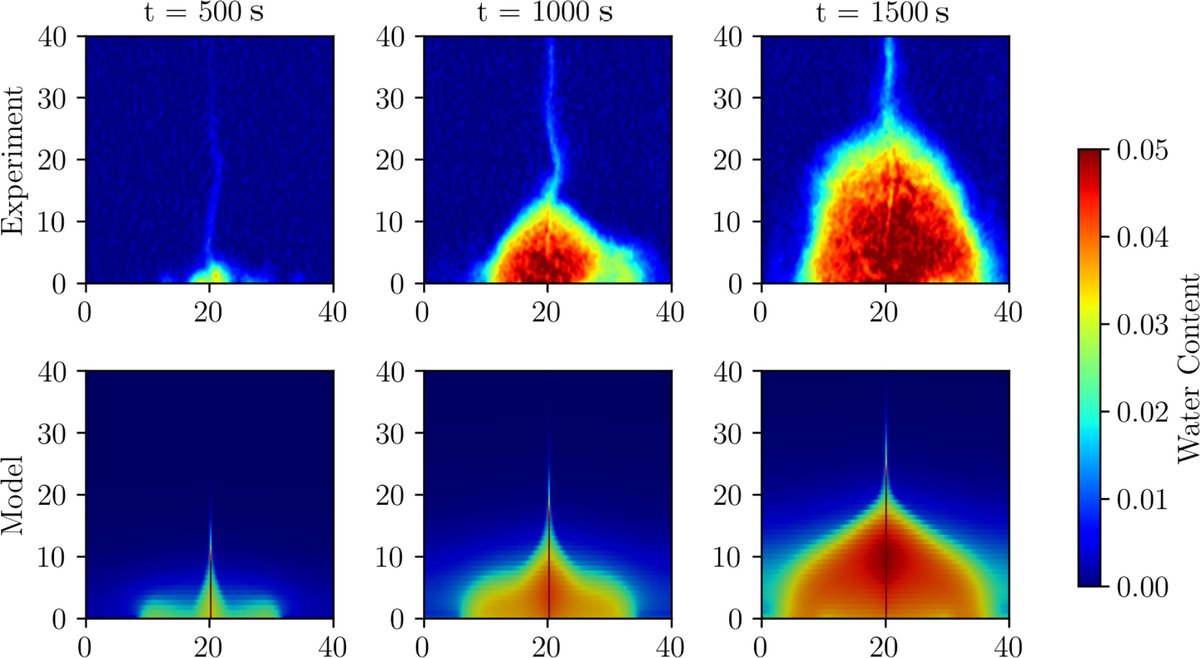
Les images de tomographie neutronique, présentées sur la lgine du dessus, révèlent comment l'eau s'accumule à l'intérieur d'un grès poreux fracturé au fil du temps. Les photos sur la ligne du bas montre le modèle numérique correspondant, qui reproduit fidèlement les observations expérimentales à 500, 1000 et 1500 secondes. Les axes indiquent la position au sein de l'échantillon, et l'échelle de couleurs représente la teneur en eau.
En réinjectant les résultats expérimentaux dans leur modèle, l'équipe a finalement pu obtenir le meilleur accord possible entre théorie et expérience. Les chercheurs ont notamment constaté que le modèle restait valable pour des substrats hétérogènes et pour ceux comportant des fractures, c'est-à-dire de minuscules fissures, ce qui constitue une excellente représentation des matériaux réels.
Cette étude, récemment publiée dans l'International Journal of Heat and Fluid Flow, et qui s'inscrit dans le cadre de recherches en cours menées depuis 7 ans, illustre avec élégance comment la théorie et les techniques basées sur les neutrons se complètent mutuellement dans la quête de description de phénomènes quotidiens essentiels - même ceux qui peuvent sembler trop complexes à décrire.
Références: Nemati, A., Séchet, P., Lukić, B., & Briffaut, M. (2026). Numerical modelling of heat and mass transfer during vapour condensation in porous media: Insights from neutron tomography. International Journal of Heat and Fluid Flow, 119, 110293. DOI: 10.1016/j.ijheatfluidflow.2026.110293
Contact ILL: Bratislav Lukić
Institutions impliquées dans la recherche: Université Grenoble Alpes, LaMcube