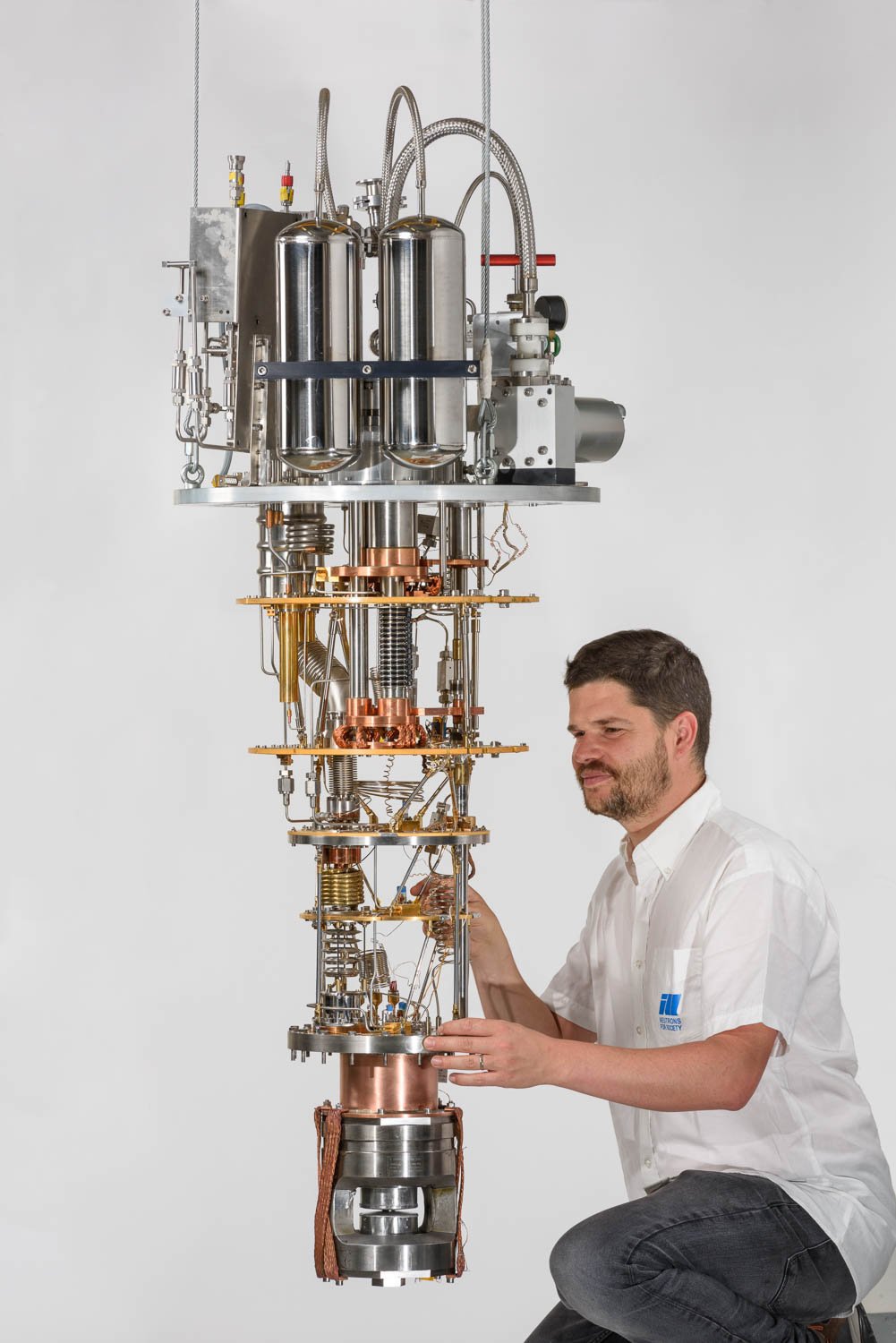
Dilution Cryostat 285OXDIL240
For carrying out extreme pressure experiments at temperatures below 4 K, we propose a cryogen-free dilution cryostat (Triton DR-200) hosting the VX-5 Paris-Edunburgh press. The pressure cell is attached to the stage of the mixing chamber and placed inside a tight calorimeter filled with 10-30 mbar of helium gas for increasing the thermalisation. The piston of the press is driven by up to 2 kbar helium gas as in the 4 K PE-cryostats 164ILCC180 and 247ILCC180.
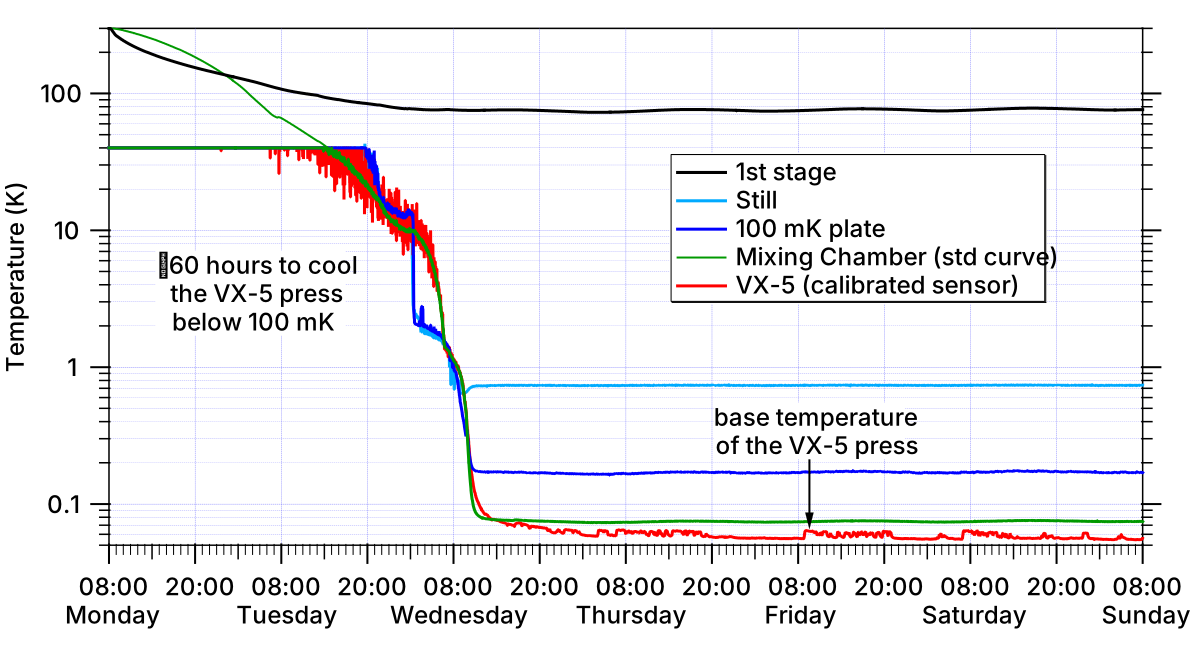
To reduce the heat load brought to the press, the high-pressure capillary is thermally anchored to all stages of the cryostat with copper braids. At 80 mK, the heat flux into the pressure cell was determined in off-line measurements to be 130 mW. The temperature of the sample was measured with Cernox and RuO2 sensors attached to the top and bottom of the press. The base temperature depends on the settings of the dilution process, the nature of the sample as well as the beam characteristics (neutron flux) of the instrument. There is significant increase in temperature of typically 50-100 mK when the beam shutter is open compared to no beam on the sample. We measured 70 mK during the commissioning phase (off-line) and 130 mK during first test measurements under load.
Reference
No long-range magnetic order in epsilon-Iron down to 160 mK, S. Klotz, M. d’Astuto, V. Joyet, H. Kobayashi, E. Lelièvre-Berna, J. Maurice, C. Payre and S. Savvin, Appl. Phys. Lett. 127, 211904 (2025), DOI 10.1063/5.0299650
| Type | Dilution cryostat |
|---|---|
Tmin |
70 mK (beam off) |
Tmax |
300K |
Instrument |