This website is being migrated. In case you don't find the information you are looking for, the old website can be found here. Thank you for reporting any anomalies to communication@ill.eu.

Cultural and Natural Heritage

Cultural and Natural Heritage play a significant role in preserving collective memory, identity, and scientific knowledge across generations. Heritage Science spans a large variety of objects and materials, as well as anything that has historic, artistic, anthropological, and natural significance. Scientific investigation in this field must reflect the breadth and depth required in dealing with very diverse materials and components.

Why Neutron Techniques?

Neutrons are an invaluable tool to push forward the frontiers of Heritage Science, most notably because ancient objects are irreplaceable and must be preserved for future generations. Non-destructive neutron techniques provide an ideal solution to characterize such specimens when sampling is not possible or desirable.

Neutron techniques provide a unique, non-destructive way to investigate a broad range of materials, even when heavily corroded or when the original surface is not accessible. The relatively weak interaction of neutrons with matter makes them a highly penetrating probe, enabling the investigation of the bulk of the sample rather than just the surface.

Unlike X-rays, neutrons interact with the nuclei of the material investigated, making them more sensitive to certain elements and isotopes.

Neutrons can also be absorbed by the sample, producing γ-ray emission. Detecting these γ-rays provides information on elemental and isotopic composition.

Applications in Heritage Science

Neutron techniques are increasingly important in cultural and natural heritage research because they provide non-invasive ways to examine rare, fragile, or unique objects that cannot be sampled or altered. They are particularly valuable for understanding:

  • Internal structure and hidden damage
  • Conservation materials and treatment history
  • Light elements, layered systems, moisture, and buried interfaces

These capabilities make neutron methods indispensable for conservation, where knowing what lies beneath the surface often determines how a treatment should proceed.

Key Neutron Techniques

Neutron Imaging

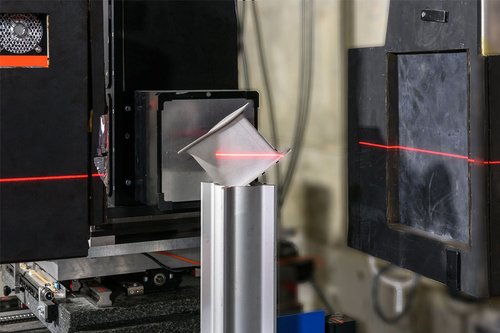
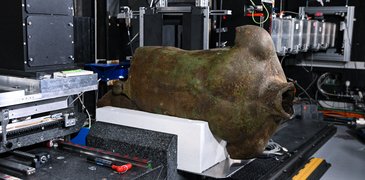
Neutron imaging is especially useful for visualizing internal features at the macroscopic scale (above 10 μm). It can reveal:

  1. Cracks, voids, and corrosion
  2. Water ingress and repairs
  3. Joins and embedded structures in artefacts, fossils, ceramics, wood, and metals
/

Neutron imaging makes it possible to study construction methods, restoration interventions, and deterioration pathways without opening or cutting the object. This is particularly valuable in conservation, where knowing what lies beneath the surface often determines how a treatment should proceed.

/

Small-Angle Neutron Scattering (SANS)

SANS adds a complementary nanoscale perspective. It can probe:

  1. Pore networks and microcracking
  2. Nanoparticle distributions
  3. Evolution of degradation products in materials such as stone, plaster, paper, pigments, polymers, and composite conservation materials
/

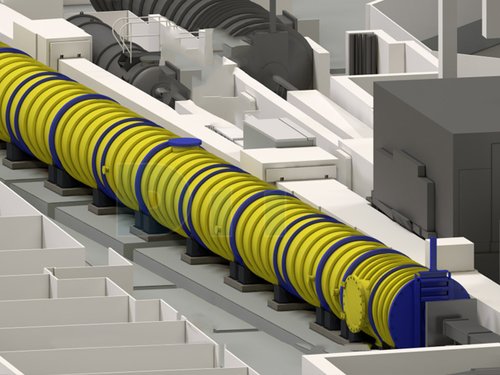
SANS is a powerful tool for studying weathering, aging, and treatment performance, especially when structural changes are too small to be captured by imaging alone. It helps explain how the fine internal architecture of a material affects its long-term stability and response to conservation measures.

/

Reflectometry

Reflectometry is particularly useful for studying thin layers, interfaces, and surface coatings, making it highly relevant for conservation problems involving paint, varnish, and protective films. It can help characterize:

  1. How coating layers are arranged
  2. How water or other species penetrate them
  3. Whether changes occurred at buried interfaces over time
/

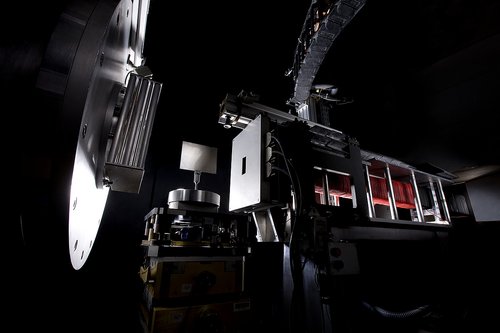
Used alongside SANS, reflectometry can connect surface-sensitive information with nanoscale structural insight, giving conservators a clearer picture of both the layered architecture and the aging history of the varnish system.

/