

That’s elementary, my dear HOLMES
20 Dec 2025Neutrons shed light on the fundamental building blocks of our universe
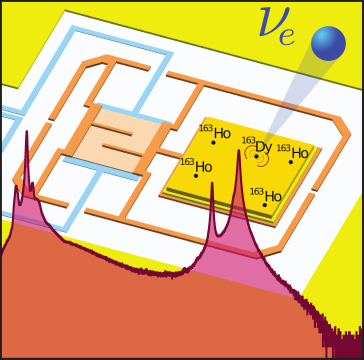
Illustration combining the HOLMES detector layout and measured spectrum.
A cosmological contradiction
Over the past centuries, we have learned an enormous amount about our Universe: how it came into existence, how it evolved – eventually allowing life as we know it to emerge – and which fundamental forces govern it. This knowledge has grown thanks to continuous progress in scientific theories and experimental methods, allowing us to investigate nature with ever-increasing precision.
One of the most successful theories in modern physics is the so-called Standard Model of particle physics. It describes the fundamental building blocks of matter – all known elementary particles – and three of the four fundamental forces: the electromagnetic, weak and strong interactions (gravity is not included). Despite its remarkable success, physicists know that the Standard Model cannot provide a complete description of nature, and are actively searching for physics beyond it.
One important indication came from the discovery that neutrinos – electrically neutral elementary particles, often described as the elusive cousins of electrons – have a mass, however tiny. This was particularly significant because the original formulation of the Standard Model assumed that neutrinos were massless. Understanding the origin of their mass is therefore an important step towards a more complete theory of fundamental particles and their interactions. Moreover, neutrinos may hold important clues to some of the unanswered questions about our universe, such as matter-antimatter asymmetry. Understanding neutrinos better could therefore help us move towards a more complete picture of the origin and evolution of our universe.
From neutrons to neutrinos
The HOLMES experiment is part of the international effort to determine the mass of the electron neutrino. It exploits the radioactive decay of holmium-163 (¹⁶³Ho), an isotope that transforms into dysprosium-163 while emitting an electron neutrino. The key to the experiment is to measure the energy released during this decay: the neutrino escapes carrying away part of the energy, and its mass can therefore be inferred from the energy spectrum of the decay, particularly close to its endpoint.
The production of the required holmium isotope relied on the exceptionally high neutron flux available at the Institut Laue-Langevin (ILL). Samples of enriched erbium-162 (¹⁶²Er) were irradiated with neutrons in the ILL's high-flux reactor. Neutron capture first transforms erbium-162 into erbium-163, which subsequently decays into the desired holmium-163. This process ultimately produced more than 100 MBq of radioactive holmium.
The resulting mixture of erbium and holmium was then chemically separated at the Paul Scherrer Institute (PSI) in Switzerland to obtain purified holmium. The isotope was subsequently selected and implanted into specially designed, ultra-sensitive detectors known as low-temperature microcalorimeters. Operating at temperatures close to absolute zero, these detectors measure the tiny temperature increase caused by the energy deposited during each radioactive decay. Almost all the energy is captured, except for the fraction carried away by the neutrino. This exceptionally efficient calorimetric approach makes it possible to investigate the neutrino mass without detecting the neutrino itself.
After two months of measurements, using an array of 64 detectors, the experiment recorded approximately 70 million decay events. The analysis established an upper limit of 27 eV/c² for the effective electron-neutrino mass (at 90% credibility). Although this is not yet a competitive limit compared with other direct neutrino-mass measurements, it represents an important milestone for the calorimetric approach and demonstrates the potential of this technology for future, more sensitive experiments.
On the way towards new discoveries
Importantly, and in addition to the numerical success of this experiment, it also provided a crucial step forward in the field of future, highly sensitive experiments in particle physics.
This complex project, requiring highly interdisciplinary and international teamwork, provides a glimpse at the very core of the universe we live in. By continuously pushing the boundaries of modern science, we are getting closer to solving the remaining mysteries of our cosmos - perhaps of of the most challenging experiences driven by human curiosity.
Beyond this first physics result, HOLMES has also achieved an important technological milestone. It has demonstrated the feasibility of combining highly sensitive low-temperature detectors with a scalable readout system, allowing many detectors to operate simultaneously. This is an essential step towards future experiments involving much larger detector arrays and aiming to reach sub-electronvolt sensitivity.
This complex project, bringing together expertise in nuclear physics, neutron science, chemistry, detector development and particle physics, is a remarkable example of interdisciplinary and international scientific collaboration. It also illustrates how neutrons, through their ability to transform atomic nuclei, can contribute to answering some of the most fundamental questions about the Universe we live in. By continuously pushing the boundaries of experimental precision, we are getting closer to understanding the still mysterious properties of neutrinos and to solve some of the mysteries of our cosmos.
Reference: Alpert BK, Balata M, Becker DT, Bennett DA, Borghesi M, Campana P, Carobene R, De Gerone M, Doriese WB, Faverzani M, Ferrari Barusso L. Most stringent bound on electron neutrino mass obtained with a scalable low-temperature microcalorimeter array. Physical Review Letters. 2025 Oct 3;135(14):141801. https://doi.org/10.1103/s9vl-7n24
ILL instrument: PF2
ILL contact: Ulli Köster